
Why Budget Day matters, even if you never read a single table
India’s story today is read in many places on factory floors, in classrooms, in hospitals, on new highways, and in the quiet confidence of families who believe tomorrow can be better than yesterday. Over the decades, India has also grown into a country whose choices are noticed far beyond its borders: in diplomacy, in technology, in disaster response, in the way it builds public systems at scale, and in the sheer weight of its people and aspirations. But inside the country, the real measure of progress still comes down to everyday questions: Will my child get a better education? Will there be steady work? Will healthcare be more accessible? Will the cost of living feel manageable? Will the future feel more secure?
The Union Budget is the one day when those everyday questions get answered, directly or indirectly, through allocations, incentives, and how that concerns an Indian citizen.
The Union Budget is where a country’s priorities meet its people’s realities
Most of us understand budgeting before we ever learn the word “economy”. A household budget is not just a list of expenses. It is a set of choices shaped by values: education over indulgence, health over vanity, repairs over purchases, saving for the future while still living in the present.
A nation’s budget works the same way only the scale is larger, and the consequences touch millions at once.
Formally, the Union Budget is the Central Government’s annual financial plan. It lays out how resources are expected to come in, and how they will be used across national needs. Under the Constitution, it is presented as the Annual Financial Statement for a financial year that runs from April 1 to March 31. But the deeper truth is this: the Budget is one of the most powerful mirrors of what a government believes the country needs right now and what it is willing to prioritise for the years ahead.
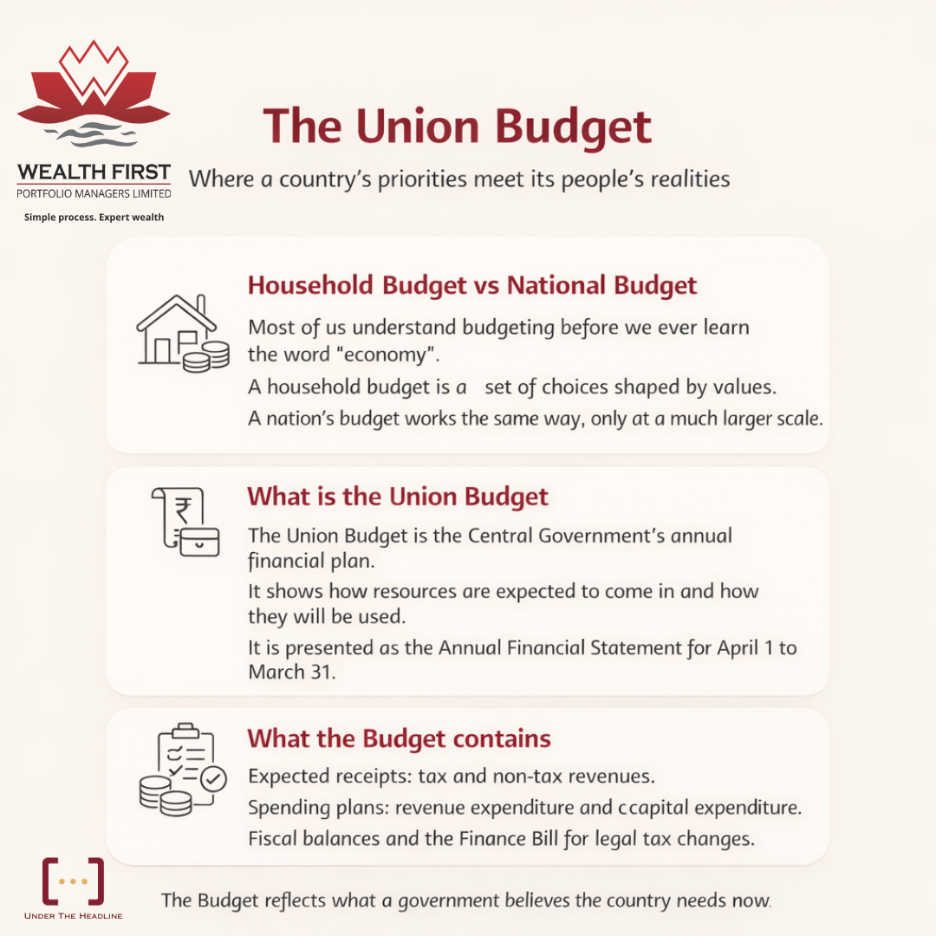
Practically, what we call ‘the Budget’ is not one file but a set of connected documents. One set explains expected receipts: tax revenues and non-tax revenues, plus other receipts. Another set maps out spending: day-to-day ‘revenue’ expenditure and longer-term ‘capital’ expenditure that builds assets. A separate statement pulls these together into the headline fiscal balances, including how much borrowing is planned and how large the deficit numbers are. And the Finance Bill is where many tax proposals get translated into legal changes that Parliament is asked to approve.
How a budget shapes the socio-economic fabric of a country
Even when people do not read the budget documents, they live the budget’s outcomes. In practical terms, a budget has an ability to shape a nation in five enduring ways:
- It influences fairness.
Taxation and public spending determine how the burden and benefits of governance are shared. When designed well, the system feels balanced. When designed poorly, it can feel heavy on some and distant from others.
- It builds capability.
Spending on infrastructure, schools, hospitals, public safety, and technology is not just “spending”. It is the country investing in its ability to function better tomorrow than it does today.
- It protects dignity.
Support for food security, livelihoods, health, and education suggests that the state recognises that a nation cannot call itself strong if large parts of its population remain one illness, one accident, or one bad season away from hardship.
- It strengthens institutions.
Budgets often come with reforms, new systems, new rules, simplification, and accountability structures. These changes shape how well government machinery serves the public.
- It signals intent.
A budget is also a statement of direction. It tells citizens what the government is focusing on whether it is jobs, skills, rural support, innovation, manufacturing capability, energy transition, or social welfare.
These five roles become sharper when you look at the moment India is in right now.
India’s current socio-economic context: hope, pressure, and the work in between
India’s present reality carries both momentum and strain, often in the same frame.
On one side, there is visible progress: improving connectivity, expanding digital public services, stronger public delivery systems in many areas, and a growing focus on long-term national capacity physical and institutional. There is also a larger ambition of building a more prosperous, more capable India in the decades ahead.
On the other side, the everyday pressures remain real and unevenly felt. Many families still experience:
- the anxiety of stable work and income, especially for younger people entering the workforce,
- the tension between rising aspirations and limited opportunities in some regions,
- the weight of healthcare costs when public access is strained or uneven,
- the challenge of education quality, not just enrolment,
- and the reality of inequality, where progress can feel closer to some than others.
This is why budgets matter. They are not magic. They do not solve everything in one year. But they set the tone for what the state will build, what it will protect, and what it believes deserves priority.
Why a few Budgets became turning points
India’s budget history is not a straight line. It is better understood as a series of moments where the country’s needs, constraints, and ambitions forced a new approach. Some decisions were bold, some were cautious, and some were responses to difficult circumstances. The significance of these moments lies not in nostalgia, but in what they reveal about how India adapted.
The modern Budget enters India (1860): the beginning of a structured fiscal system
Long before independence, budgeting in India took a modern administrative form on 7 April 1860, associated with James Wilson, during colonial governance. This system was designed for administrative control and extraction, not national development. Still, it created a structure that independent India would inherit and then attempt to repurpose for nation-building.
1947: an interim Budget in a country trying to stand up after partition
Independent India’s first Budget was presented on November 26, 1947, by R.K. Shanmukham Chetty. It covered an interim period and arrived during a time of deep disruption of partition, displacement, rehabilitation needs, and the immediate pressures of governing a new nation. In such moments, budgets are less about ambition and more about stabilisation, security, and survival with dignity.
1957–58: wealth tax and the early push to address inequality through fiscal tools
The introduction of 1957: Wealth-tax Act and the early equity push reflected a young republic’s attempt to build a tax system that aligned with its social objectives. The idea was to broaden the base and respond to inequality by taxing certain forms of wealth. With time, the country’s approach changed, and wealth tax was later discontinued. The important lesson here is not whether the tool was perfect, but that the state was actively experimenting with how to balance equity with practicality.
1973–74: the “Black Budget” and the hard truth of constraints
The 1973–74 Budget (with an overall deficit noted at Rs. 550 crores in the speech) is often remembered as the “Black Budget”, associated with severe fiscal stress. This period reflects a reality every country eventually faces when resources are constrained, and pressures rise together; governments must make painful choices. Such moments leave behind a lasting reminder that economic stability is not an abstract concept; it is what allows a nation to invest in its future without constant firefighting.
1986: MODVAT and the slow work of fixing complexity in taxation
The introduction of MODVAT, effective 1 March 1986, was not a glamorous announcement, but it mattered deeply. It aimed to reduce the cascading burden of indirect taxes where tax gets layered upon tax through the production chain. Reforms like this are important because they reduce friction and complexity in the economy. They also show a shift in thinking: from patchwork solutions to system design.
1991: a Budget that marked a decisive turn in economic direction
The 1991 Budget, presented during a period of severe external and internal economic stress, is widely remembered as a watershed moment. The reforms associated with that phase loosened rigid controls, reduced barriers, and set India on a more open, competitive, and globally engaged path. This was not merely a financial statement; it was an acknowledgement that the old model was no longer sustainable, and that India needed to adapt quickly to protect its future.
1997–98: the “Dream Budget” (often dubbed) and the behavioural insight behind tax design
The 1997–98 Budget is remembered for simplifying structures and lowering certain tax rates, built on the belief that when the system feels reasonable, compliance improves. Whether one agrees with every element or not, the broader significance is valuable: taxation is not only about collection; it is also about trust, behaviour, and how citizens relate to the state.
2017: GST roll-out – “One Nation, One Tax” becomes a lived fiscal architecture
When GST came into effect on 1 July 2017, it was not just another rate change, it was a structural rewiring of how India taxes consumption across the Union and States. The public framing at the time was clear: GST was positioned as the biggest indirect tax reform since independence, meant to create “One Nation – One Tax – One Market” and reduce the internal economic barriers created by a patchwork of State and Central levies.
What makes this a turning point is the governance design behind it. GST is inherently co-operative federalism in tax administration, Centre and States running a shared system, largely technology-led, with the tax base and compliance increasingly shaped by digital reporting rather than localised discretion.
COVID-era 2021–22: the Budget turns into a recovery blueprint – vaccines + public health capacity + capex as confidence
The Union Budget 2021–22 (presented on 1 February 2021) landed in a period where fiscal policy had to do two jobs at once: stabilise lives and livelihoods and signal that the recovery would not be timid. Two announcements capture why it stands out:
- A direct provision of ₹35,000 crore for COVID-19 vaccines in BE 2021–22, with an explicit commitment to provide more if required.
- A visible pivot to health as economic infrastructure: Health and Wellbeing outlay of ₹2,23,846 crore (BE 2021–22), highlighted as a sharp increase over the previous year’s BE.
And then came the longer-horizon signal: building capacity so the next shock does not become a national emergency of improvisation. The Budget highlighted a new centrally sponsored scheme, PM AatmaNirbhar Swasth Bharat Yojana, with an outlay presented as ₹64,180 crore over 6 years, covering disease surveillance, labs, critical care blocks, and public health units.
Crucially, this wasn’t framed as only “relief”. It was paired with a strong capital expenditure push (capex proposed at ₹5.54 lakh crore for 2021–22, as per the Budget Speech), showing an intent to use public investment as a lever to revive activity and confidence.
Beyond these headline turning points, India’s standout Budget moments often arrived when the state used fiscal policy to change behaviour, not just raise or spend money by simplifying compliance, formalising activity through technology, rebalancing spending towards productive public investment, and responding to shocks with targeted support while still protecting long-term credibility. In that sense, the best Budgets were less about grand announcements and more about quietly resetting how citizens, businesses, and the state interact.
How the “Budget day” itself evolved: timing, language, and ritual
Over time, India also changed how the Budget is delivered and documented.
- The presentation time shifted from older conventions (5 pm → 11 am) to a morning schedule, making the process more contemporary and accessible.
- Budget documents began to be printed in both Hindi (circulated for the first time) and English, recognising the need for wider democratic reach.
- The Budget has long had confidentiality traditions, with strict processes and rituals like the Halwa Ceremony marking the beginning of document preparation and printing.
These details may seem ceremonial, but they reflect something deeper: the Budget is treated as a national moment, precisely because it affects so many lives at once.
2017–18: merging the Railway Budget into the Union Budget
For many decades, railways had a separate budget. The later merger into the main Union Budget reflected a more integrated approach to national planning and public finance. It also recognised that transport infrastructure is not a standalone subject; it is connected to productivity, mobility, access, and national cohesion.
From survival to systems: how India’s budget philosophy has evolved over time
Those same themes show up again when you look at how India’s budget philosophy changed over time. The most meaningful change across India’s budget history is not a single tax rate or a single year. It is the gradual evolution of how the state thinks about its role.
From rebuilding a nation to building capacity
In the early decades after independence, budgets were shaped by urgent needs of rehabilitation, food security, basic industry, and institutional creation. The emphasis was often on building national capability from a low base. That phase laid foundational assets, even if it also produced inefficiencies that later needed reform.
From control-heavy frameworks to reform and simplification
Over time, India’s budgeting approach increasingly moved toward simplifying systems, encouraging efficiency, and strengthening delivery. The shift was not overnight. It came through multiple steps some technical, some structural, some driven by crises, and some driven by ambition.
From welfare as relief to welfare as resilience
The idea of welfare has also matured. The best welfare spending is not merely a short-term relief measure; it is a way to build resilience so that a child’s education does not collapse because a parent fell ill, and so that dignity is protected even in hard times. Modern budgeting increasingly speaks the language of outcomes: not only “how much money was spent,” but “what changed because it was spent.”
From paperwork to public systems
India has steadily moved toward using technology and public infrastructure to improve delivery and reduce leakages. This changes what budgets can attempt. It allows targeting, faster rollout, and clearer measurement provided execution is strong, and institutions remain accountable.
A closing thought: the Budget is ultimately about people
It is easy to treat the Union Budget as something distant speeches, documents, columns of numbers. But if you look closer, it is the story of a country trying to meet its citizens where they are, while also preparing for where they want to go.
Every generation of Indians has lived through a different Budget reality; some inherited shortages and rebuilding, some watched the country modernise, some experienced reform and rapid change, and some now live in an India that carries both ambition and complexity.
The Budget cannot promise happiness. It cannot erase inequality in a single year. It cannot make every village and every city feel equally served overnight. But it can do something powerful when done with care: it can turn national intent into real-world capability, and it can slowly, year after year, move a country closer to a life where ordinary citizens feel less fear about the basics, and more confidence about the future.
That is why India’s budget story matters. It is not only an economic narrative. It is a human one. If you want to understand India’s direction, watch what the Budget tries to fix and what it avoids.
Disclaimer: The content shared by Wealth First is for general informational and educational purposes only and should not be considered as investment advice, research, or a solicitation to buy or sell any financial product. Past performance is not indicative of future results. All investments are subject to market risks, including possible loss of principal. Readers should consult their financial, legal, or tax advisors before making any investment decisions tailored to their personal circumstances. While utmost care is taken to ensure accuracy of hyperlinks, information and concepts, Wealth First does not guarantee completeness, reliability, or timeliness, and shall not be liable for any direct or indirect loss arising from reliance on such information. Any views expressed are strictly informational and should not be construed as guidance for investing in regulated or unregulated instruments of any kind. All articles contain no offer, inducement, or solicitation for account opening, investment, or trading activity. All characters, events and examples are fictional and used only for illustrative storytelling. Wealth First, its employees, and affiliates expressly disclaim any liability arising from interpretation or use of this material.
References:
Department of Economic Affairs, Ministry of Finance, Government of India. (n.d.). Brief description of the budget documents. Retrieved January 29, 2026, from https://dea.gov.in/brief-description-budget-documents
Government of India. (1957). The Wealth-tax Act, 1957 (Act No. 27 of 1957) [PDF]. https://www.indiacode.nic.in/bitstream/123456789/3123/1/a1957-27.pdf
Ministry of Finance, Government of India. (1947). Budget speech 1947–48: R. K. Shanmukham Chetty [PDF]. https://www.indiabudget.gov.in/doc/bspeech/bs194748.pdf
Ministry of Finance, Government of India. (1955). Budget speech 1955–56: C. D. Deshmukh [PDF]. https://www.indiabudget.gov.in/doc/bspeech/bs195556.pdf
Ministry of Finance, Government of India. (1973). Budget speech 1973–74: Y. B. Chavan [PDF]. https://www.indiabudget.gov.in/doc/bspeech/bs197374.pdf
Ministry of Finance, Government of India. (1986). Budget speech 1986–87: V. P. Singh [PDF]. https://www.indiabudget.gov.in/doc/bspeech/bs198687.pdf
Ministry of Finance, Government of India. (1991). Budget speech 1991–92: Manmohan Singh [PDF]. https://www.indiabudget.gov.in/doc/bspeech/bs199192.pdf
Ministry of Finance, Government of India. (1997). Budget speech 1997–98: P. Chidambaram [PDF]. https://www.indiabudget.gov.in/doc/bspeech/bs199798.pdf
Ministry of Finance, Government of India. (1999). Budget speech 1999–2000: Yashwant Sinha [PDF]. https://www.indiabudget.gov.in/doc/bspeech/bs19992000.pdf
Ministry of Finance, Government of India. (2015). Memorandum explaining the provisions in the Finance Bill, 2015 [PDF]. https://www.indiabudget.gov.in/budget2015-2016/ub2015-16/memo/mem1.pdf
Press Information Bureau, Government of India. (2016, November 16). Merger of rail budget with union budget. https://www.pib.gov.in/newsite/PrintRelease.aspx?relid=153672
The Economic Times. (2019, June 18). The man who created India’s first-ever budget. https://m.economictimes.com/news/economy/policy/the-man-who-created-indias-first-ever-budget/articleshow/69838774.cms
Ministry of Finance, Government of India. (2002). Key to Budget Documents: Budget 2002–2003 [PDF]. https://www.indiabudget.gov.in/budget_archive/ub2002-03/keybud/keybud2002.pdf
Development Monitoring and Evaluation Office (DMEO), NITI Aayog, Government of India. (2024). Best Practices Compendium on Outcome Budgeting [PDF]. https://dmeo.gov.in/sites/default/files/2024-01/Best-Practices-Compendium-on-Outcome-Budgeting.pdf
Press Information Bureau, Government of India. (2017, June 30). GST roll-out – Complete transformation of the Indirect Taxation Landscape. https://www.pib.gov.in/PressReleasePage.aspx?PRID=1494580
Central Board of Excise and Customs, Government of India. (2017, June 13). Press Release: Outreach programmes ahead of GST roll-out (scheduled from 01.07.2017) [PDF]. https://cbic-gst.gov.in/pdf/press-release/outreachprg-13062017.pdf
Ministry of Finance, Government of India. (2021). Union Budget 2021–22: Budget Speech [PDF]. https://www.indiabudget.gov.in/budget2021-22/doc/Budget_Speech.pdf
Press Information Bureau, Government of India. (2021, February 1). Key Highlights of Union Budget 2021–22. https://www.pib.gov.in/PressReleasePage.aspx?PRID=1693907
Press Information Bureau, Government of India. (2026, January 27). Final stage of preparations for Union Budget 2026–27 commences with ‘Halwa Ceremony’. https://www.pib.gov.in/PressReleasePage.aspx?PRID=2219158
Government of India, Ministry of Law and Justice, Legislative Department. (2024). The Constitution of India [As on 1st May, 2024] [PDF]. https://cdnbbsr.s3waas.gov.in/s380537a945c7aaa788ccfcdf1b99b5d8f/uploads/2024/07/20240716890312078.pdf