
A real-life Indian family moment that shows why insurance prevents one bad day from becoming a long setback
The message arrived at 6:28 a.m., blinking on Kavya’s phone like a tiny reminder that adulthood has its own alarm clock. “Premium payment successful.”
She didn’t open it right away. She already knew which one it was. Every year, around the same week, the same two messages would arrive; health insurance first, and then the bike’s motor insurance quiet as a ceiling fan, constant as the gas cylinder’s “only one bar left” feeling.
From the kitchen, the pressure cooker gave its first whistle. Ahmedabad mornings were still cool in March, but the flat had already warmed up with routine: tea, tiffin, uniforms, and the soft chaos of a middle-class home trying to start on time.
Nikhil walked in, hair half-set, office shirt draped over his arm, and that familiar look on his face the one that appeared whenever a debit alert arrived. “Again?” He asked, nodding at the phone like it was a person who needed a lecture.
Kavya finally tapped the notification and placed the phone face-up near the sugar jar. It was, as expected, the health renewal. A second message followed. Motor renewal, too. Nikhil made a sound that wasn’t quite a sigh and wasn’t quite a laugh. “Two premiums in one morning. It’s like the bank is doing a duet.”
Kavya poured tea into two steel cups and pushed one towards him. “It’s once a year,” she said. “Once a year is also enough to ruin a month,” he replied, already calculating what they could postpone. His mind did that automatically; school fee dates, grocery cycles, EMI, and their biggest dream sitting in the middle like a sacred plate at a family function.
The home.
They were saving for a down payment by December. Not a mansion just a modest 2BHK with a balcony that caught evening light. Kavya had visited it twice and had already imagined their daughter’s books on the windowsill.
Nikhil sipped tea, then said carefully, like he was proposing a practical solution, not a fight. “This year, can we… skip one of them? Just for one year. The health one can stay, okay. But bike insurance. What’s the worst that can happen? I ride slow.”
Kavya didn’t raise her voice. She simply set her cup down with a firmness that made the spoon clink. “The worst thing that can happen is not always the point,” she said. “Sometimes the point is what happens after the worst.”
Their daughter, Mishti, wandered in, hair puffed like a cotton ball, and immediately began looking for biscuits. “What’s premium?” She asked through a half bite. Nikhil opened his mouth. Kavya answered first, not as a lecture, more like a sentence she had rehearsed silently for years.
“Premium is what we pay so that one difficult day doesn’t become many difficult months.”
Mishti nodded as if this explained everything. Children accept metaphors easily, but adults question them because adults know what everything costs. Nikhil tried to smile. “Very poetic,” he said. “But the bank doesn’t accept poetry, Kavya.” “No,” she said, softer now. “But our family does.”
The argument didn’t continue. It never did in the morning. It simply got folded into the day like laundry neatly, temporarily, waiting for a later moment when both of them would pretend they had always agreed. By 9:30 a.m., the house had shifted to ordinary life: school bag zips, office calls, a quick check of traffic on Google Maps. Nikhil left on the bike, helmet strapped; his lunchbox balanced like a fragile promise.
Kavya watched him go, then did something she always did. She glanced at the pencil marks on the wall near the fridge. Mishti’s height, measured year after year. Proof that time moved forward even when everything felt repetitive.
That day, time moved too fast. At 12:07 p.m., Kavya’s phone rang from an unknown number. She almost ignored it, thinking it would be a courier or a spam call. Something in her chest urged her to answer anyway.
“Madam, are you Nikhil Mehta’s family?” The voice asked. Her throat tightened. “Yes.” “This is from the hospital,” the caller continued quickly, as if speed could soften the news. “Small accident, madam. He is stable. You should come.” The words “small” and “hospital” don’t cancel each other. They sit together in your body like two stones.
Kavya doesn’t remember locking the door. She doesn’t remember putting on her dupatta. She only remembers the auto’s rattling noise and the city smearing past: flyovers, billboards, chai stalls, and a man selling raincoats with sudden urgency.
In the hospital, everything looked too clean for how messy her mind felt.
Nikhil lay on a bed near the emergency bay, a bandage on his forehead, his shirt collar marked with a small stain that made her heart jump even though the doctor later said it looked worse than it was.
He saw her and immediately tried to lighten the moment; husbands are trained in this particular helplessness. “Sorry,” he said. “I’m fine. Just… a stupid skid. Road was slick.” Kavya didn’t scold him. She held his hand, then turned towards the nurse, the doctor, and the papers. Fear always arrives with forms.
A junior doctor explained: observation, scan, and a few hours of monitoring. “Nothing serious,” he said, with the calm confidence of someone who says this ten times a day. Kavya nodded, but her mind was already doing what Nikhil’s mind usually did – calculating. Not just money. Consequences.
At the billing counter, they asked for details. Kavya opened the folder she kept for emergencies copies, ID proofs, and policy documents. She had made it years ago, almost sheepishly, like someone who fears being called “too much”. Today, it didn’t feel like “too much”. It felt like oxygen.
The staff checked the health insurance details. It wasn’t magic nor was it instant. There were steps, verifications, and still a deposit. But there was one difference that mattered: Kavya didn’t have to choose between the scan and the December down payment.
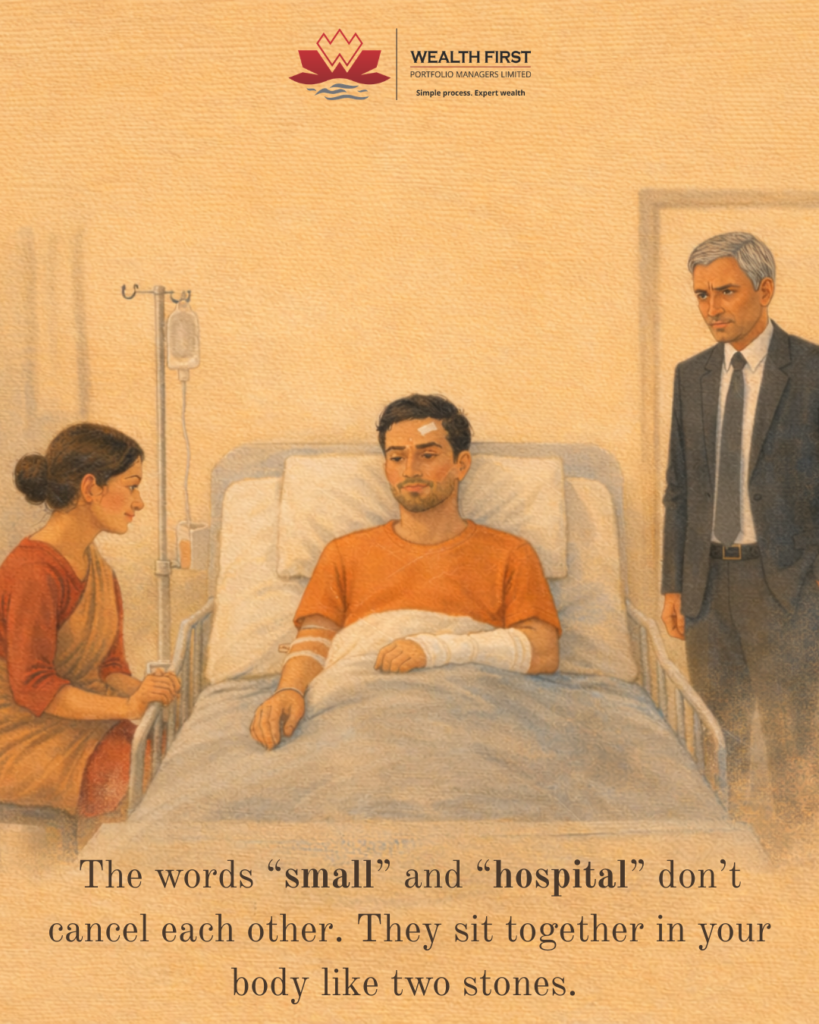
Insurance didn’t remove pain. It didn’t remove any inconvenience. It didn’t erase the bill. But it prevented panic from becoming a second emergency.
By 2:00 p.m., Nikhil was moved to a room. Kavya finally allowed herself a full breath. That was when the second problem walked in, and this one was wearing anger instead of a bandage.
A man stood near the nurse’s station, talking loudly enough for everyone to hear. Behind him, a younger man held a phone, recording like he was collecting evidence for a courtroom and content for the internet. “You people ride like you own the road,” the older man snapped when Kavya approached. “My car is damaged. We have dashcam footage. We will file a case.”
Kavya’s stomach dropped. Nikhil had said “skid”. He hadn’t said “car”. She turned to Nikhil. He avoided her eyes for a second enough to tell her the truth.
“I did bump them,” he admitted quietly. “Not much. But enough to dent their bumper. They followed the ambulance.” In another life, Kavya might have cried. In this one, she did something more useful: she asked for details.
“Please share the car number, the location, and your contact,” she said, steadily. “He is injured. We will not run away from this.”
The man looked surprised by her tone calm, not defensive. Kavya opened her phone and found the motor insurance message from the morning. The one Nikhil wanted to skip. Her chest tightened not with triumph, but with something more complicated: relief that had arrived wearing guilt.
She called the insurer helpline, reported the incident, followed the steps: photos, documents, timing, and intimation. Again, no miracles. Just process. But sometimes the process is exactly what saves a family. It gives a path when emotions want to create a mess.
The older man’s voice lowered slightly when he heard the word “insurance”. Still annoyed, but less theatrical. Less threatening. And then, when he finally introduced himself, the twist landed with a quiet cruelty.
He was the brother of the builder’s representative they were negotiating with for the December flat.
Kavya felt her face warm. In one second, the accident had tied itself to their dream. She imagined the worst: the deal collapsing; the family labelled “trouble,” the balcony slipping away because of one slippery road.
The man glanced at Kavya’s file folder, at the small note sticking out Down payment target: Dec and raised an eyebrow. “You’re booking in Shreenath Aangan?” He asked. Kavya swallowed. “We are trying.”
A pause. Then, unexpectedly, his expression softened by a few degrees. “My sister mentioned you,” he said. “You’ve been punctual with the instalments so far. And… you’re handling this properly.” He looked at Nikhil, then back at Kavya. “Just don’t disappear.”
“We won’t,” Kavya said.
That evening, back home, the flat looked unchanged – the same sofa, the same wall clock that ran two minutes ahead, the same fridge magnets. Yet Kavya felt like she had returned to a different version of the same life.
Mishti sat beside her, unusually quiet. Children don’t understand medical billing, but they understand fear. They absorb it. “Papa is okay?” She asked. “Yes,” Kavya said, pulling her close. “Papa is okay.”
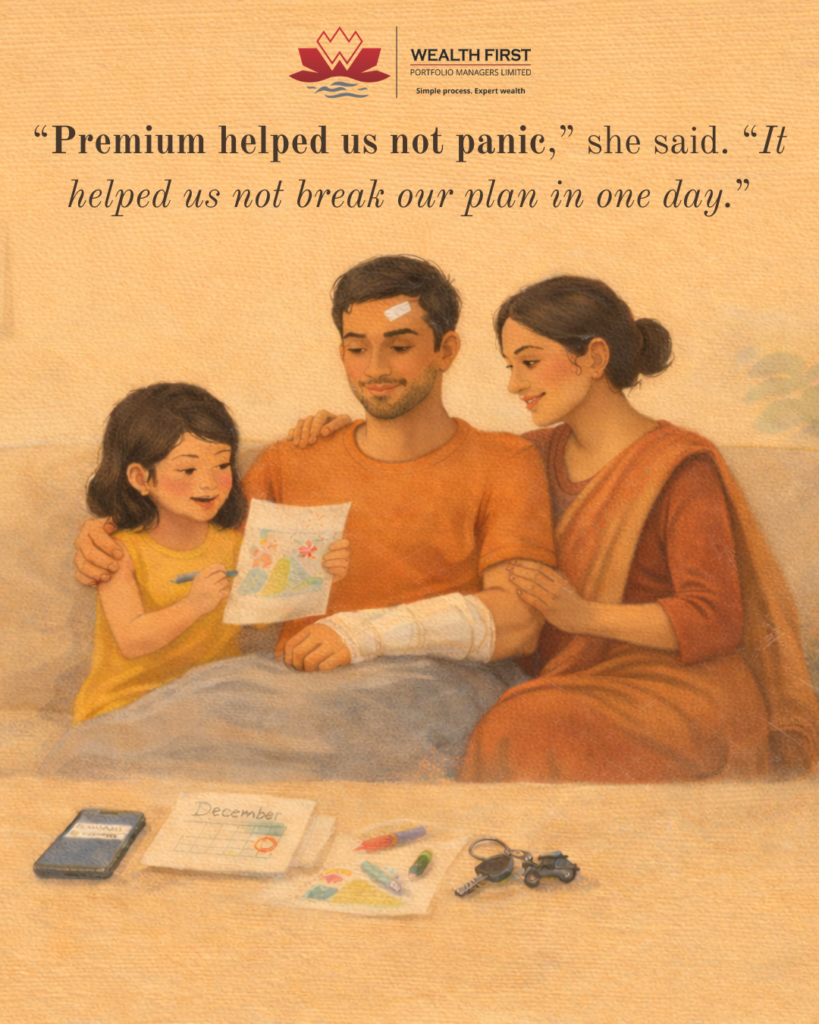
Mishti looked serious, then asked softly, “So premium helped?” Kavya smiled, pressing a kiss into her hair. “Premium helped us not panic,” she said. “It helped us not break our plan in one day.”
From the bed, Nikhil chuckled, wincing a little. “Also,” he added, “premium helped me not become famous on someone’s dashcam.” Kavya finally laughed; the tired, honest kind. Then Nikhil turned his head towards her, the humour fading into something more tender.
“You were right,” he said. “I always thought insurance is money wasted when nothing happens. Today, nothing ‘big’ happened. And still… it mattered.” Kavya nodded. She didn’t say “I told you so.” That would have been cheap.
“Insurance isn’t about expecting tragedy,” she said. “It’s about protecting choices.” Nikhil’s eyes drifted to the calendar on the fridge. December circled in red. “We’re still on track?” He asked, quietly.
Kavya opened the notebook where she tracked their goal. The numbers had changed slightly, yes. There would be out-of-pocket amounts. There would be follow-ups and paperwork and the dull headache of claims.
But the dream hadn’t been sacrificed. “Yes,” she said. “We’re still on track.” Outside, rain began, soft and steady, making the streetlights glow like blurred coins. Kavya walked to the cupboard and slid the document folder back into its place. Not like it was a task. Like it was care unshowy, unglamorous, and deeply human.
Before switching off the lights, she asked herself a question that didn’t feel like finance at all. It felt like family.
The Money Behaviour This Reveals
Nikhil and Kavya’s real mistake wasn’t the skid, it was the temptation to treat protection as optional when life looked normal. What the day revealed is simple: insurance isn’t a “product” you buy for comfort; it’s a system that prevents one incident from forcing rushed, costly trade-offs. Health cover absorbed the hospital shock; motor cover gave a clean path through the conflict. The real win wasn’t saving money; it was protecting the December plan from turning into a sacrifice.
Calm Rule
Don’t fund emergencies from your dreams. Use insurance so sudden medical or accident costs don’t hijack your goals, savings, or long-term plans.
The 15-Minute Habit
The next weekend, do a two-policy, two-number check (set a 15-minute timer):
Health insurance:
- Confirm it’s active, renewal date, and who is covered.
- Save the insurer helpline + policy number in your phone notes.
- Keep one soft-copy of the policy card in your phone’s “Favourites/Files.”
Motor insurance (car/bike):
- Confirm it’s active and note expiry date.
- Save the insurer claim number and the steps to report an accident.
- Keep a tiny “accident checklist” in Notes: photos, location, time, other vehicle number, and contact.
Then set one tiny routine: add renewal reminders 21 days before expiry for both policies.
Review Cadence
Monthly:
- Check that auto-debits or reminders are in place.
- Ensure your emergency contact list and policy numbers are easy to find on your phone.
Yearly (renewal month):
- Re-check who is covered, update nominee details, and confirm contact info.
- Review whether your coverage still matches your current life (family size, medical needs, vehicle usage) and remove any confusion before the next “unexpected day.”
The Curious Quest
If one unexpected day tested your plan not your patience, your plan what would protect your family’s choices from turning into sacrifices?