
When instant applause starts feeling like intelligence.
It began on an ordinary Tuesday evening.
Rohan had just left office, squeezed into the back seat of a cab, and opened his phone the way most tired people do now not to think, only to switch off. A colleague had sent him a game link that afternoon with a laughing message: “Be careful. Highly addictive.”
The game looked harmless. Bright colours. Fast music. One clear rule: tap whatever lights up.
Each quick tap earned coins. Every fifth tap triggered fireworks. Every tenth one unlocked a louder burst of sound, a higher streak, and a line across the screen that said: Brilliant. Unstoppable. Elite reflexes.
By the time he reached home, Rohan had already begun to believe he was good at it.
Three days later, he had stopped reading the screen properly. He no longer looked for patterns, meanings, or logic. He looked only for movement. Flash. Tap. Spark. Smile. The game did not ask him to think. It asked him to react.
On Sunday, his niece Myra asked to try.
She played differently. She slowed down. She waited half a second before touching the screen. She seemed to be searching for a pattern in the colours, trying to understand whether one move changed the next. The game punished her for it. No fireworks. No celebration. No proud badge. Rohan beat her in less than a minute.
He laughed. She handed the phone back quietly and said, “It is not really a game, na? It just wants you to keep tapping.”
At the time, he brushed it aside. But that sentence stayed. Because she was right. The app was not rewarding judgement but obedience to stimulation. Tap fast. Feel smart. Repeat. And once a system teaches you that speed deserves celebration, patience starts to feel like failure.
What Was Really Happening Here
This was not just a story about a game. It was also a story about how the mind starts trusting rewards before it has judged results. And this is where these biases enter:
Present bias: It means the tendency to prefer immediate gratification and overvalue the present over the future. That is why quick applause feels more convincing than slow progress. A flash on the screen feels real now. Patience asks for belief in something that has not shown up yet.
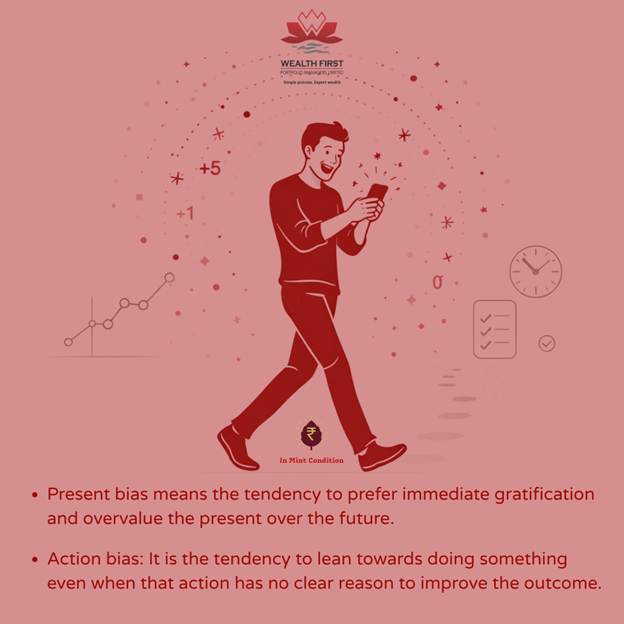
Action bias: It is the tendency to lean towards doing something even when that action has no clear reason to improve the outcome. That is why constant tapping can start feeling like a skill. Action gives emotional relief. It creates a feeling of control, even when it adds no real advantage.
Put together, these two tendencies create a very modern illusion: if the system rewards me, I must be doing well. But reward and usefulness are not the same thing. Some systems do not train judgement. They train reflex.
That is what made the game dangerous. It did not teach strategy. It taught speed. And once speed starts feeling intelligent, stillness begins to feel like failure.
How This Shows Up in Investing
This is where the story stops being about a game and starts being about money.
Some investing platforms do not only make access easier. They also make activity feel rewarding. A nudge, a streak, a celebration, or a well-timed prompt can make movement feel meaningful before the decision has actually proved useful. IOSCO notes that digital engagement practices can help investors engage better, but can also encourage more frequent trading, push investors towards higher-risk products, or influence them to change strategy without fully understanding the risks.
That is where confusion begins. The mind starts mistaking action for progress. If the screen rewards the behaviour, the behaviour starts feeling correct. If the app applauds the move, the move starts feeling intelligent. But investing does not become wiser just because it becomes more active.
This is the deeper trap behind short-termism. The investor is no longer responding only to the market but also responding to design. And once the brain gets used to quick emotional rewards, patience starts to feel dull, even when patience is a better financial habit.
Not every simple interface is a problem. Clear design can improve access, understanding, and participation. The danger begins when the reward is attached to the act itself, not to the quality of the decision. That is when a person can slowly start trusting stimulation more than judgement.
In the end, that is what gamified finance can do so quietly. It does not always tell people to make bad decisions. It can simply make unnecessary decisions feel satisfying. And over time, that feeling can become its own kind of addiction.
The Closing Scene
A few days later, Rohan’s office held a casual tournament during lunch. Same game. Same screen. Same players. But the final round was different.
There were no fireworks. No badges. No cheering sounds. Some tiles had to be ignored. Some had to be left untouched. The winner would not be the fastest person in the room. The winner would be the one who knew when not to tap.
Rohan lost in less than a minute. Not embarrassingly. Just truthfully.
For the first time, he saw the earlier rounds for what they had really been. They had not trained him to play better. They had trained him to react faster. And because the game had praised him at every step, he had mistaken conditioning for competence.
That evening, he sat beside his father at home. The television was on mute. A market update was crawling silently across the bottom of the screen. Rohan looked at his phone, then placed it face down on the table.
After a pause, he said, “Some things make you feel smart while making you worse.” His father smiled, without rushing to explain anything. “Yes,” he said. “That is why not every reward deserves trust.”
No lesson followed. The room stayed quiet. At first, the silence felt strange, almost empty. Then, slowly, it began to feel clean. As if for the first time in days, his mind was not being pulled by something flashing at it. And in that stillness, he understood what the game had never wanted him to learn: The hardest move is not always the fastest one. Sometimes, it is the one you choose not to make.
Key Takeaways
- Instant rewards can make shallow action feel meaningful.
- Present bias makes what feels good now appear more important than what works later.
- Action bias makes doing something feel safer than waiting, even when waiting is wiser.
- In investing, activity can feel productive without being useful.
- A rewarding interface is not the same as a sound decision.
- Long-term wealth usually depends more on patience, clarity, and discipline than on constant reaction.
——————————————————————————————————
Read Next:
- India’s Oil Economy: What Changed, Why It Matters, and How the Iran Conflict Could Affect Growth
- The Coach Who Never Reviewed the Replays
——————————————————————————————————-
Disclaimer
The content shared by Wealth First is for general informational and educational purposes only and should not be considered as investment advice, research, or a solicitation to buy or sell any financial product. Past performance is not indicative of future results. All investments are subject to market risks, including possible loss of principal. Readers should consult their financial, legal, or tax advisers before making any investment decisions tailored to their personal circumstances. While utmost care is taken to ensure accuracy of information, Wealth First does not guarantee completeness, reliability, or timeliness, and shall not be liable for any direct or indirect loss arising from reliance on such information.
This content is prepared purely for educational awareness in accordance with SEBI and Exchange guidelines permitting non-promotional, concept-based communication. It does not contain any offer, inducement, or advertisement for account opening, product purchase or trading activity. All characters, events and examples are fictional and for illustrative storytelling only.