
Wealth First explains how yields show the real fruit your investments bear and why they matter beyond bonds.
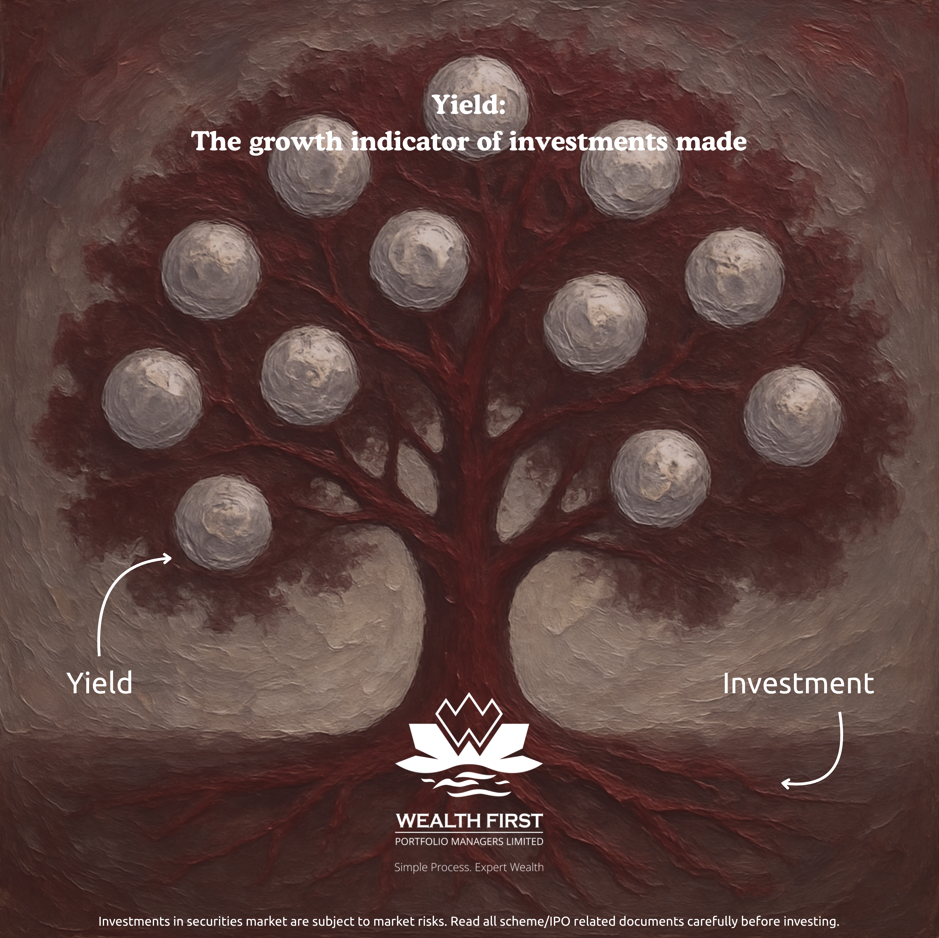
Imagine a tree. You plant it, nurture it, and over time, it begins to bear fruit. The tree is your investment, and the fruit it produces each season is your yield: the income or return that your money generates over time.
In finance, yield carries the same meaning: it tells you how much your investment earns relative to its cost.
What Is Yield in Financial Terms?
In simple words, yield is the rate of return you earn on an investment, usually expressed as a percentage.
Mathematically,
Yield = (Income from Investment / Investment Value) × 100
For bonds and other fixed-income instruments, this typically refers to the interest or coupon income you receive relative to the bond’s current price or face value.
Yield helps investors understand what they are earning on their investments; not just in absolute terms, but in relation to the money they’ve put in.
Example: How Yield Works
Suppose you purchase a bond with:
- Face value = ₹1,000
- Annual interest (coupon) = ₹80
If you bought the bond at its face value (₹1,000), your yield is:
(₹80 ÷ ₹1,000) × 100 = 8%
Now, let’s say the bond’s market price changes:
- If the bond trades at ₹900 → Yield = (₹80 ÷ ₹900) × 100 = 8.89%
- If the bond trades at ₹1,100 → Yield = (₹80 ÷ ₹1,100) × 100 = 7.27%
When bond prices fall, yields rise; and when prices rise, yields fall.
This inverse relationship between bond prices and yields is one of the most important principles in fixed-income investing.
Why Yield Matters to Investors
1. Measure of Income Efficiency
Yield helps investors assess how effectively their capital generates income, especially in bonds, deposits, or dividend-paying instruments.
2. Comparison Tool
It allows investors to compare returns across instruments say, between a corporate bond and a government security, or between a fixed deposit and a debt mutual fund.
3. Indicator of Market Conditions
Rising yields usually indicate falling bond prices, often reflecting inflation or higher interest rates. Falling yields signal the opposite, i.e. lower rates or improved credit outlook.
4. Crucial for Retirement and Stability Planning
For those relying on regular income, yield is a key factor in designing portfolios that provide steady cash flow with manageable risk.
Beyond Bonds: Where Else Yield Appears
While the term “yield” is most common in fixed-income investments, it also applies elsewhere:
- Dividend Yield – the dividend earned per share relative to its current market price.
- Earnings Yield – inverse of the P/E ratio; shows how much a company earns per rupee invested in its stock.
- Yield to Maturity (YTM) – total return an investor can expect if a bond is held until maturity.
Each type of yield provides a different perspective — income efficiency, valuation, or long-term return potential — depending on the asset class.
In essence, yield is not just a number; it’s the heartbeat of income generation across investments.
What to Keep in Mind While Evaluating Yields
- Don’t Chase High Yields Blindly:
A higher yield often means higher risk, too. The issuer may be compensating for lower credit quality. - Consider Inflation:
A nominal 7% yield may not mean much if inflation is at 6.5%. Always think in terms of real yield (yield minus inflation). - Understand Tenure and Liquidity:
Long-term bonds may offer higher yields but lower liquidity. Match duration with your goals. - Review Consistency:
Look for instruments that deliver stable, reliable yields, not just short-term spikes.
Yield vs. Return — Are They the Same Thing?
Many investors use yield and return interchangeably, but they are not identical.
While both express performance, they measure different aspects of it.
| Aspect | Yield | Return |
| Definition | The income (interest or dividends) generated by an investment as a percentage of its cost or current value. | The total gain or loss on an investment, including income and changes in market value. |
| Focus | Ongoing income flow (interest, dividends). | Overall performance (income + capital appreciation or depreciation). |
| Timeframe | Typically annualized. | Can be over any period. Daily, monthly, or long-term. |
| Example | A bond paying ₹7,000 on ₹1,00,000 = 7% yield. | If the bond’s price rises 5%, total return = 12%. |
In short: Yield tells you how much income your investment produces. Return tells you how much wealth it actually creates. When evaluating investments—especially in bonds, mutual funds, or dividend-paying equities—investors should look at both yield and total return together.
High yield doesn’t always mean high return, especially if capital value declines. Likewise, some lower-yield investments can deliver higher total returns through price appreciation over time.
Key Takeaways
- Yield represents the income earned on an investment as a percentage of its cost or price.
- In bonds, yield is inversely related to price.
- It helps in comparing income potential across instruments.
- Yield exists not just in bonds but also in dividends, earnings, and deposits.
- Always assess yield alongside risk, inflation, and time horizon.
Disclaimer
The content shared by Wealth First is for general informational and educational purposes only and should not be considered as investment advice, research, or a solicitation to buy or sell any financial product. All information in emails, posts, and articles from Wealth First is intended solely to increase financial awareness. Past performance is not indicative of future results. All investments are subject to market risks, including possible loss of principal. The given example(s) is/are only for illustrative purposes only and hypothetical in nature. Readers should consult their financial, legal, or tax advisors before making any investment decisions tailored to their personal circumstances. While utmost care is taken to ensure accuracy of information, Wealth First does not guarantee completeness, reliability, or timeliness, and shall not be liable for any direct or indirect loss arising from reliance on such information.