
Shikhar, a young professional, likes to keep things a certain way, and he does it with a kind of hyper energy. Being a finance enthusiast, he obsessively reads newspapers, newsletters, articles, blogs and almost all the information he can find around finance and wealth management. Shikhar constantly feels he must know everything in order to feel like he’s in control. He reads and analyses market, economic, and geo-political news, and how these might affect markets. You just name the topic, and you’d find the information about it on Shikhar’s email inbox.
Interestingly, he organises and arranges all his emails by topic, type and whatever else he can think of, just to keep them handy. For Shikhar, the inbox wasn’t just a tool; it had quietly become proof that he was on top of everything. But he never takes any action based on all the information. Getting notifications seems the most thrilling moment of his day.
Without realising, Shikhar fell prey to the behavioural biases. In the end, he felt like he was controlling everything, but was he? Beneath the colour-coded folders and saved links, something else was happening inside his mind.
Information Overload Bias
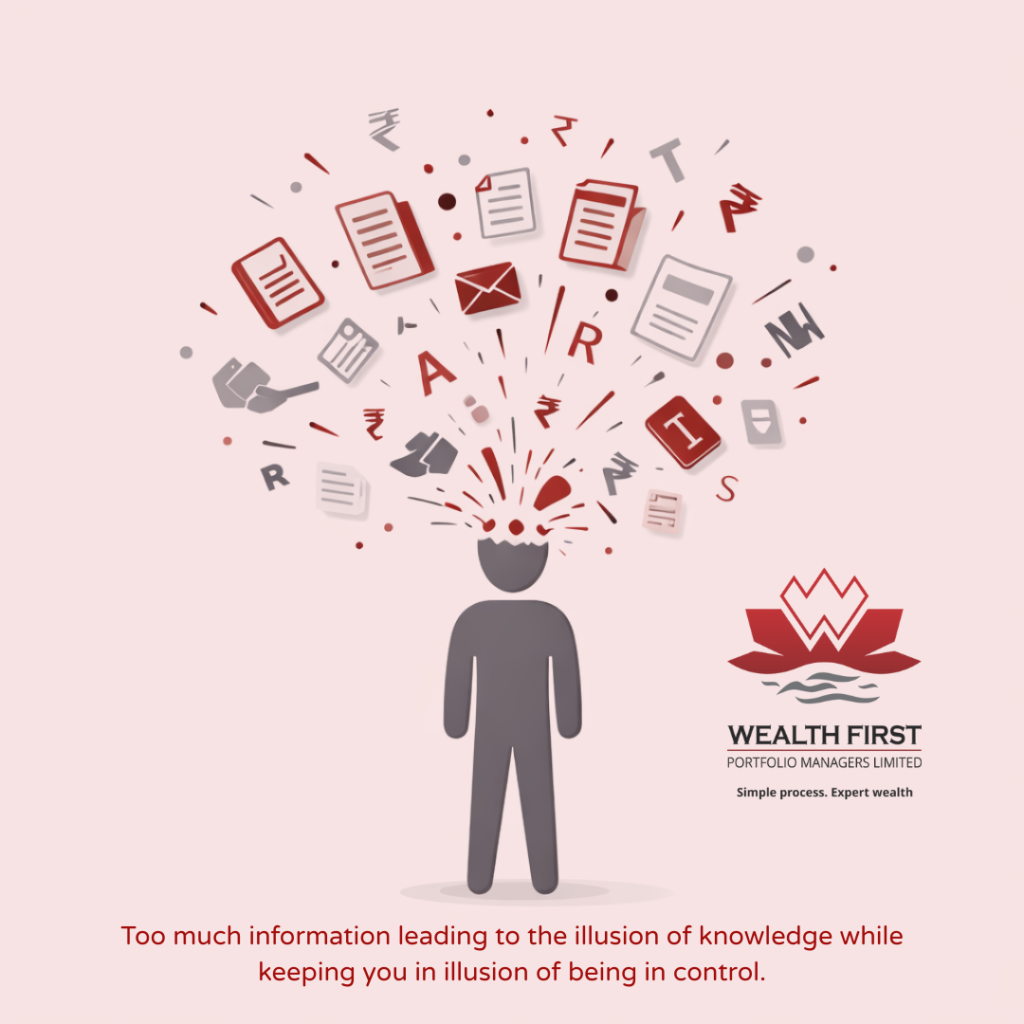
Information overload is a term used to describe the excessive amount of data people may be exposed to on a daily basis. This abundance of information can have negative mental and physical effects on some individuals.
You must have seen people around you who consume information like it’s their primary food for survival. Acting on the basis of information is another thing. However, the overload of information may feel overwhelming. In investing, this state can amplify other behavioural biases and make it harder to act calmly and selectively.
Shikhar wasn’t comfortable with not having all the information about everything around him. No matter how overwhelming it feels, or how much of his time it consumes, he wants to know everything or else he’d feel restless.
Well, you have the information, but do you have the knowledge?
Illusion of Knowledge
Closely related to the Dunning-Kruger effect or the overconfidence effect, it is a cognitive bias where you feel you understand a topic well because it seems familiar (recognition from passive exposure), but you can’t reliably retrieve, explain, or apply it, so your actual understanding is shallower than your confidence suggests.
Shikhar did know a lot about finance and wealth management. However, when someone would ask him about the market movements or the recent news, he wouldn’t be able to answer it because he just consumed the information instead of understanding it deeply.
That’s where he’d feel the sense of losing control.
Illusion of Control
The illusion of control bias is a type of cognitive bias – not an emotional one – that leads people to overestimate their ability to control events that are actually uncertain. This can lead people to engage in unusual behaviours.
Shikhar, despite feeling like he knew everything, always felt the need to control everything which ultimately led him to misinterpret a situation and had to go through a huge loss. The learning he got from this experience was that not everything is under your control. It is not at all possible to know everything and being able to control it.
He finally understood that being informed is NOT the same as being prepared. Most of us are not very different from Shikhar. The inbox keeps filling; notifications keep arriving, and there is always one more article to read. Do you remember Krish, from our previous article, who had the same kind of obsession with being in control? Well, the real question isn’t how much information we can access, but what we choose to slow down for, understand, and act on thoughtfully. that pause, where information ends and preparation begins, is often where better decisions are made.
Key Takeaways
- Information overload can create the illusion of productivity while quietly draining time, energy, and focus.
- The illusion of knowledge makes familiarity feel like understanding, even when we can’t explain or apply what we’ve read.
- The illusion of control tempts us to believe that more data automatically means more control over uncertain events.
- Being informed is not the same as being prepared; preparation needs reflection, filters, and a plan for action.
- Pausing to ask, “What will I actually do with this information?” can gently turn reading from noise into insight.