

Subtitle: Why feeling in control isn’t the same as being in control.
Krish loved apps and dashboards. His phone was filled with them. Health trackers, habit apps, smart-home widgets, etc. Every morning, he’d tap through 12 different apps: sleep score, step count, weekly goals, productivity bars and more. If a number dipped, he made an adjustment. If a trend rose, he felt a sense of achievement. It gave him the feeling that he was steering everything; that life was a system he could monitor, tweak and optimise.
Then came the monsoon power outages. During a prolonged electricity cut, his Wi-Fi stopped working. Half of his apps wouldn’t sync. His fitness tracker showed wildly inaccurate readings. The “smart thermostat” wouldn’t connect. His health app wrongly recorded his steps, and his budgeting app refused to load.
Yet he kept tapping, swiping, refreshing; as if the act itself restored his control. By evening, he felt anxious, frustrated, and overwhelmed. Nothing worked, but he couldn’t stop trying to fix what wasn’t even in his hands. It was only when the electricity finally returned that he realised something uncomfortable:
All this time, the app dashboards didn’t give him more control. They only gave him the illusion of it.
Understanding The Illusion of Control
Krish’s experience reflects a well-studied behavioural bias called the illusion of control.
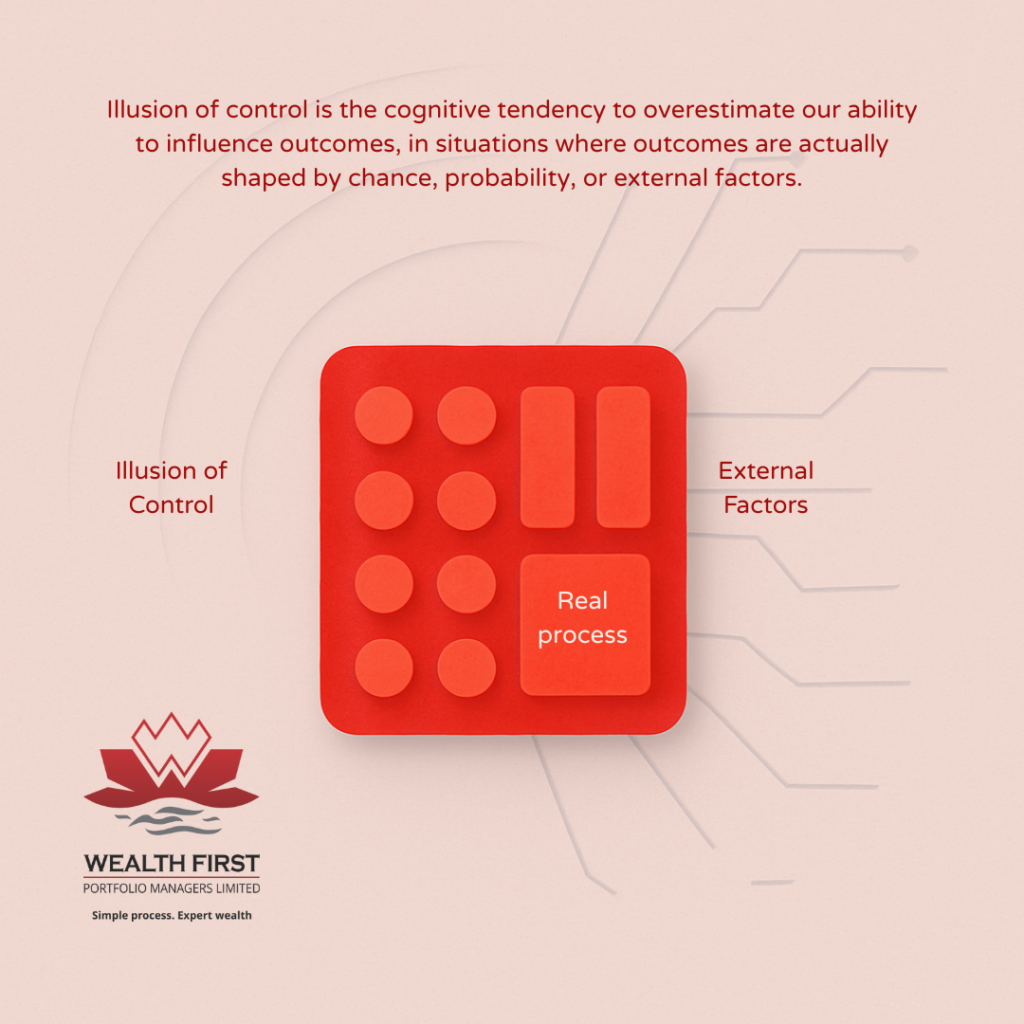
The illusion of control is the cognitive tendency to overestimate our ability to influence outcomes, in situations where outcomes are actually shaped by chance, probability, or external factors.
This bias is powerful because it feels good to the mind and gives a sense of control to people involved. For humans, predictability feels safe, and uncertainty feels threatening. So the mind subconsciously inflates our sense of influence, even when the outcome is random.
Examples are everywhere:
- Tapping the screen harder as if it makes something load faster
- Feeling lucky in games of chance
- Overplanning what cannot be controlled
Remember that the illusion always tries to calm us. But in reality, it misguides us.
The Illusion of Control in Finance
This bias becomes particularly dangerous in financial contexts.
Because investing offers data in the form of dashboards, charts, forecasts, analysis, and many tools, it creates the appearance of precision and predictability. But markets — like weather, traffic, or human behaviour — cannot be fully controlled or forecasted with 100% accuracy. Here’s how the illusion plays out in investing:
1. Overconfidence in predictions
People might firmly believe they can fully forecast short-term movements, even though markets are inherently influenced by countless variables beyond their reach.
2. Mistaking information for control
More data → more dashboards → more updates doesn’t equal more control. It often leads to overtrading, impulsive moves, or chasing false signals.
3. Attributing success to skill and losses to luck
This selective interpretation reinforces the illusion. If outcomes appear favourable, it feels like evidence of competence, not chance or market conditions.
4. Attempting to control timing
It shall be understood that the data and information available are not the problem, but the illusion that their mere presence means we can fully control what’s happening is an issue. People may try to “time” markets with precision, even though abundant research shows how unpredictable short-term movements are. In essence, the illusion of control creates overconfidence, misplaced risk-taking and a false sense of mastery over uncertainty. It forces investors into believing that they are in full control; but often, it isn’t.
When the power returned, Krish finally saw his apps sync again. New numbers appeared. Charts updated. Scores recalibrated. But instead of relief, he realised he had spent hours trying to “fix” data he never controlled in the first place. All the refreshing, adjusting, tapping — none of it changed the actual conditions. The apps didn’t fail him. His expectations that they will be up 100% of time did.
That night, he removed half the widgets that were only because he felt a sense of control. He kept only what he could genuinely influence such as his sleep routine, hydration, daily exercise, and his spending habits.
Everything else? He accepted it as uncertainty and not a system to optimise. For the first time in years, he felt lighter. Not because he gained more control, but because he finally recognised where control ends.
Key Takeaways
- The illusion of control makes uncertainty feel manageable, even when it isn’t.
- Data and dashboards can create false confidence, leading to overreaction or excessive risk-taking.
- Liquidity and buffers matter, because real life remains unpredictable.
Read Next
- Wealth First Explains: Diversification: The Simplest Insurance Against Uncertainty
- Wealth First Explains: Volatility: Riding the Waves with Confidence Amid Uncertainties
Disclaimer: The content shared by Wealth First is for general informational and educational purposes only and should not be considered as investment advice, research, or a solicitation to buy or sell any financial product. Past performance is not indicative of future results. All investments are subject to market risks, including possible loss of principal. Readers should consult their financial, legal, or tax advisors before making any investment decisions tailored to their personal circumstances. While utmost care is taken to ensure accuracy of information and concepts, Wealth First does not guarantee completeness, reliability, or timeliness, and shall not be liable for any direct or indirect loss arising from reliance on such information. All articles contain no offer, inducement, or solicitation for account opening, investment, or trading activity. All characters, events and examples are fictional and used only for illustrative storytelling. Wealth First, its employees, and affiliates expressly disclaim any liability arising from interpretation or use of this material.