
Why “I already know” is the most expensive sentence in personal finance
It was a Sunday evening in Dadar, and the ground felt like a different country. The air smelt of wet mud, hot bhel, and that last-minute hope a local match can create. Coach Raghav stood near the boundary rope; arms folded tight, as if willpower could hold the team together. His whistle hung from his neck, unused. He wasn’t watching the scoreboard. He was watching faces. After a win, he searched for pride. After a loss, he searched for excuses.
That day, they lost the match. A clean loss; no bad luck, no injustice. The opponent was simply better, and a few mistakes repeated so predictably that the team had seen them coming except the one man who could correct them.
The boys gathered for the post-match talk.
“We played well,” Coach Raghav said. “The pitch was slow. The light was bad. The umpire rushed it. And that bowler; he had his day.” Rajiv shifted his weight and stared at his shoes. Another boy wiped his face with his jersey, not from sweat, but from that familiar helplessness that comes when a loss teaches nothing.
The assistant coach, Rajesh, cleared his throat. “Sir… should we watch the replay tonight? I recorded it.”
Coach Raghav’s jaw tightened, as if the word replay itself was an insult. “No need,” he said. “Replays confuse people. Too much analysis kills instinct. Anyway, the outcomes are random. What’s the point dissecting them?”
And just like that, the session ended. Not with learning, only storytelling. And stories, when they are designed to protect ego, become expensive over time.
The hook we all fall for
Raghav genuinely believed he was protecting the team. He believed replay-watching would create doubt, fear, and overthinking. But what he was really protecting was his self-image. Because a replay does one uncomfortable thing: it argues back. It doesn’t care about seniority or confidence. It simply shows what happened.
And when it shows the same loop of repeating mistakes, it asks a hard question: Are you learning or only explaining? That question matters far beyond a cricket ground, because most of us do the same thing in quieter ways. We protect our confidence by avoiding evidence that could improve our decisions.
The bias behind the whistle
Two behavioural patterns were running the show here.
Self-serving bias: It is when wins feel like skill, and losses suddenly become circumstances. When things go right, we tell ourselves that we chose well. When things go wrong, we reach for the weather, the timing, the situation, the world, etc.
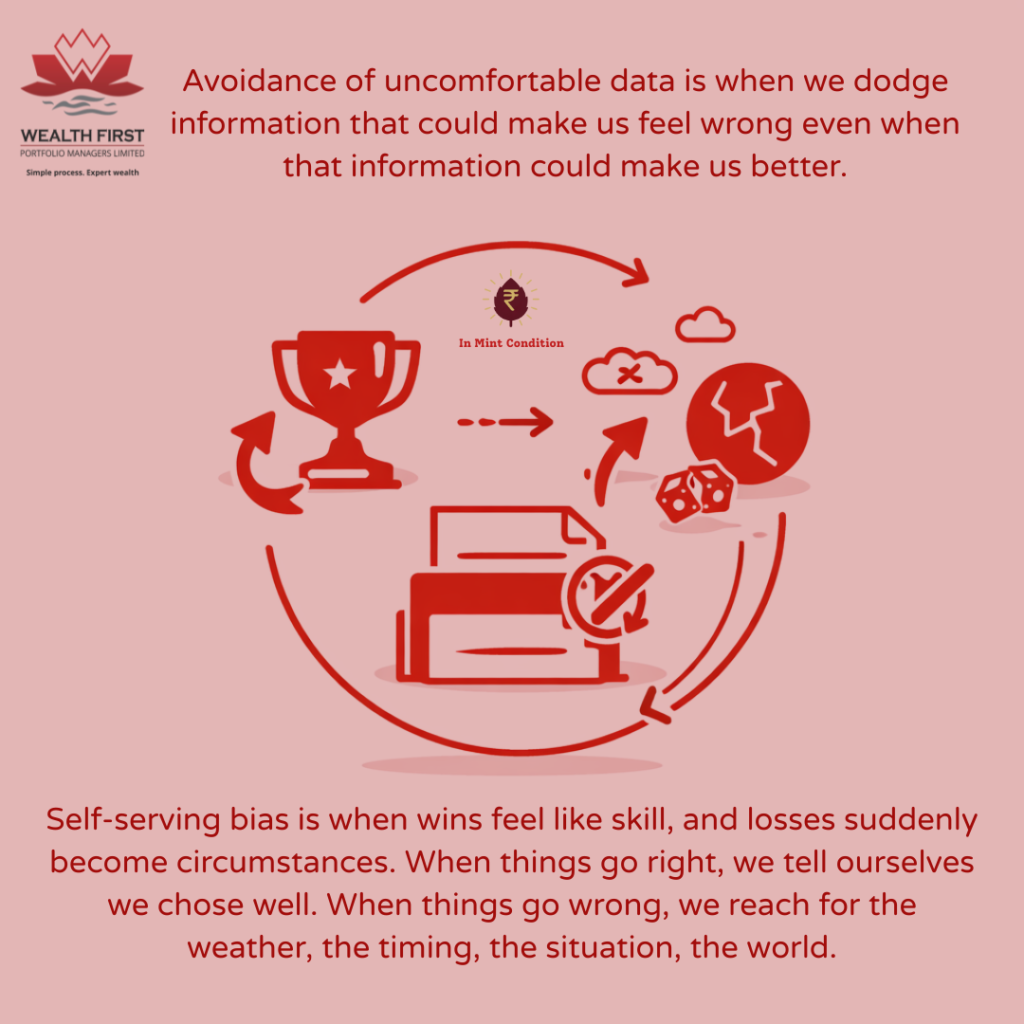
Together, they create a dangerous comfort zone: confidence stays intact, but the feedback loop dies. And without feedback, learning doesn’t compound. And money decisions are one of the easiest places for this comfort zone to hide because no one sees the replay but you.
Where this shows up in real-life money decisions
Many people don’t lose money because they are careless. They lose learning because they don’t review.
It sounds calm when someone says:
- “I don’t check statements. It only increases stress.”
- “Good or bad outcomes happen. It’s all timing and luck.”
- “Let it be. I’ll deal with it later.”
But underneath, these are often the financial version of refusing to watch match replays. Not because people are irresponsible, but because review forces a mirror and mirrors can feel rude on difficult days.
A few common patterns:
- A family takes a large loan assuming “income will increase anyway,” and later blames “the economy” when EMIs begin swallowing choices.
- Someone delays protection planning because “nothing will happen,” and later calls a medical shock “bad luck,” instead of admitting the gap.
- A person sets aside money for a goal, then repeatedly dips into it for weddings, gadgets, travel, or festivals and later says, “Life is expensive,” without noticing the habit.
The pattern is the same: behaviour repeats, but the justification changes. And the most expensive part is not the one-time outcome. It is the repetition; mistakes returning in new clothes.
Back to the ground
Two weeks later, the team lost again. This time, the boys didn’t look shocked. They looked resigned like they had already memorised the ending. Sameer waited until the last player left and approached Coach Raghav quietly.
“Sir,” he said, “I’m not trying to prove you wrong. I only want to show you a pattern.” Coach Raghav exhaled. “Sameer, I’ve played enough cricket to know what happened.” Sameer nodded. “I agree. You know cricket. But do we know our habits?”
He opened his phone and played a short clip. Ajinkya attempted a run, hesitated, turned late, and got caught short. It looked like a one-off until Sameer swiped. The same hesitation from the previous match. Then another clip. Then another.
Coach Raghav’s face changed not dramatically, just quietly, like a man seeing his reflection in an unkind mirror. Sameer kept his voice gentle. “This is not about blame. It’s about pattern.”
Coach Raghav stared for a long moment. Then he said something rare for him: “I didn’t notice this.” Sameer replied, “That’s the point of the replay, Sir. It notices even when we don’t.”
That night, Coach Raghav didn’t sleep early. He watched the game. Then he watched it again not to punish anyone, but to understand. And the next day, at practice, he didn’t shout. He didn’t lecture. He asked one question that changed the air: “What did we expect would happen… and what actually happened?”
The boys leaned in not out of fear, but relief. Because finally, the team had moved from emotion to learning.
The replay ritual
If you want to reduce self-serving bias and data avoidance in your financial life, you don’t need a complicated system. You need a ritual that is small enough to follow, and honest enough to work.
1) Write a decision note before you act
In 2–3 sentences, capture what you are choosing, why you are choosing it, and what you expect it to do for your life goal. This is not paperwork. It is a time-stamped mirror.
2) Fix the review date in advance
Monthly or quarterly is enough. Pre-deciding the review reduces the chance you avoid it when it feels uncomfortable.
3) Review the process, not your pride
Ask: Did I follow the plan or the mood? What was within my control? What was not? This keeps you from rewriting history.
4) Take one lesson and one habit
One thing to repeat. One thing to avoid. Learning compounds best when it is small and repeatable.
5) Add a second-opinion checkpoint
Sometimes we avoid data because we don’t want to face it alone. A trusted family member or a qualified professional can help you keep the feedback loop alive.
The closing scene
A month later, the team won a close match. The boys celebrated like only teenagers can. Coach Raghav smiled then looked at Sameer and said, almost like an apology, “Tonight, we still watch the replay.”
Sameer grinned. “Even after a win?” Coach Raghav nodded. “Especially after a win. That’s when ego gets careless.” He turned to Ajinkya. “Good improvement. Tell me what you changed.” Ajinkya replied, “I stopped guessing. I started checking.”
Coach Raghav didn’t say anything more. He didn’t need to. Because that is what growth sounds like – quiet honesty, repeated.
Key takeaways
- Self-serving bias makes us credit wins to skill and blame losses on circumstances, which blocks learning.
- Avoiding uncomfortable data protects feelings in the short term but quietly repeats mistakes in the long term.
- Reviewing your decisions is not self-judgement. It is a feedback loop that keeps your process honest.
- A small replay ritual (decision note + fixed review + one lesson) is often enough to build stronger habits over time.
- The goal is not perfection. The goal is a process you can trust even when emotions run high.