
What was announced on 1 February 2026, what the RBI signalled on 6 February 2026, and how households can interpret the combined message
As of 12 February 2026, the Union Budget (presented on 1 February 2026) is now “announced”, but not “done”. The Budget Session is still underway, with debates continuing before a scheduled recess. That matters because the Budget is a process; proposals move through discussion, scrutiny, and legislation before they become operational reality.
In the same first week of February, the RBI Monetary Policy Committee (MPC) met from 4–6 February 2026 and held the repo rate at 5.25%, while retaining a neutral stance. Put simply: fiscal policy (Budget) and monetary policy (MPC) arrived back-to-back, and together they shape the environment for interest rates, borrowing, liquidity, and market narratives.
This edition of Wealth First Explains focuses on interpretation, not prediction and on understanding the channels through which policy decisions typically flow into personal finances and portfolios.
The “policy mix” in one line: growth support with flexibility on rates
Budget 2026–27 signaled continued emphasis on public capital expenditure (capex), with the Finance Minister proposing an increase to ₹12.2 lakh crore to “continue the momentum”, alongside measures such as an Infrastructure Risk Guarantee Fund.
At the same time, the Budget framed its fiscal path clearly: fiscal deficit estimated at 4.3% of GDP for 2026–27, with net market borrowings from dated securities estimated at ₹11.7 lakh crore (a key number bond markets track because it relates to government borrowing supply).
On the monetary side, the MPC kept rates unchanged and reiterated data-dependence via a neutral stance.
Taken together, the combined message looks like this: keep the growth engine supported via fiscal spending priorities, while keeping monetary policy flexible to respond to incoming inflation and growth data. That “flexibility” is exactly what a neutral stance is meant to preserve.
Borrowing costs: why “repo unchanged” doesn’t automatically mean “EMI unchanged”
The MPC’s decision was straightforward: repo unchanged at 5.25%, SDF at 5.00%, MSF and Bank Rate at 5.50%, with the stance kept neutral.
But household borrowing costs do not move one-to-one with the repo rate, especially when the decision is a “hold”. In practice:
- Transmission takes time. Banks re-price loans and deposits based on a mix of funding costs, competition for deposits, liquidity conditions, and risk appetite not only the repo.
- A “pause” is still information. It can anchor short-term expectations in markets, but actual lending-rate changes depend on conditions within the banking system.
So, the most accurate takeaway is not “rates will not move”, but “immediate changes are not automatic; pricing adjusts as financial conditions evolve.”
Growth and inflation: what the MPC’s numbers actually said
The MPC document references India’s First Advance Estimates, stating real GDP growth estimated at 7.4% (y-o-y) in 2025–26, and projects CPI inflation for 2025–26 at 2.1% (with quarterly projections also provided).
It also describes inflation in late 2025 as low (for example, 0.7% in November and 1.3% in December 2025, as per the MPC text) and explains factors it is watching including food supply conditions, precious metals’ price behaviour, energy prices, geopolitics, and weather-related risks.
For investors, the useful point is not the exact decimal, but the implication: When inflation is well below the 4% target, the policy conversation tends to shift from “fighting inflation” to “balancing growth, stability, and financial conditions” while still keeping an eye on shocks that can reverse the story.
Budget 2026 and market sentiment: why capex + fiscal math matters
Budget headlines often focus on “who got what”, but markets frequently track three deeper signals:
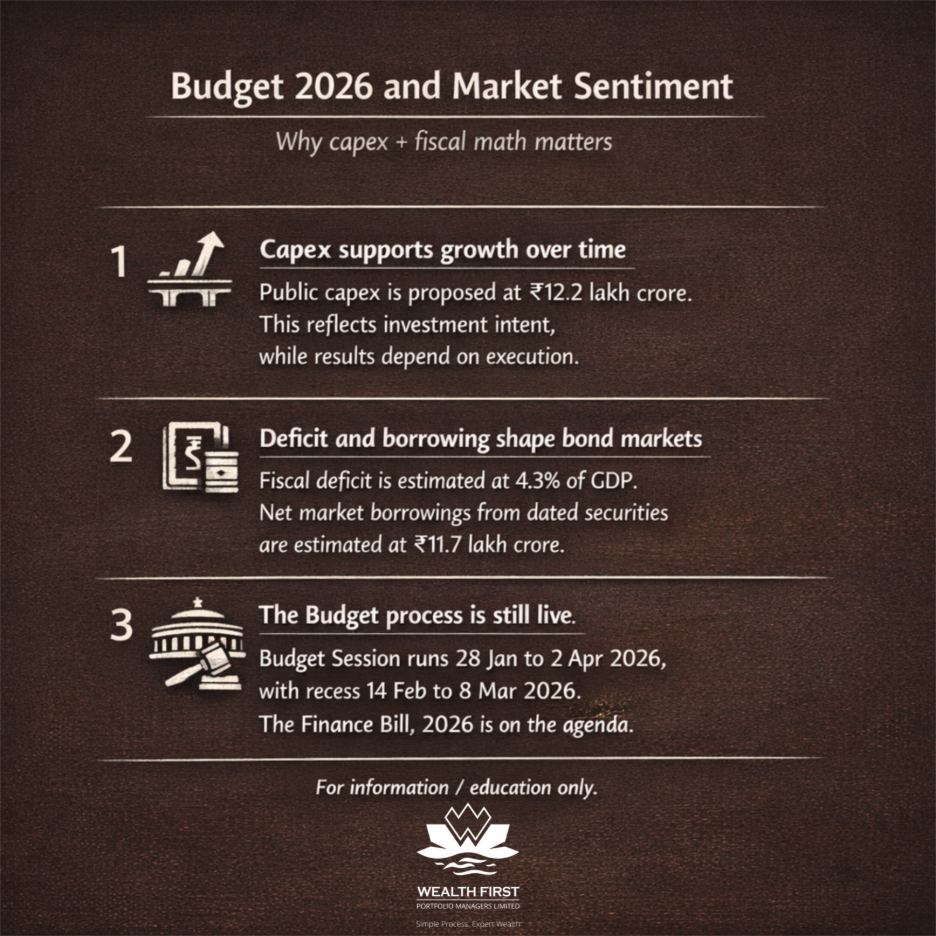
1) Capex as a medium-term growth lever
The Budget speech explicitly proposes raising public capex to ₹12.2 lakh crore, and pairs that with infrastructure-linked enablers (including risk guarantees and asset monetisation routes like REIT-related proposals).
In market language, this is read as: government-led investment intent, which can influence expectations around demand, corporate earnings cycles, and credit growth though outcomes still depend on execution.
2) Fiscal deficit and borrowing as a bond-market anchor
The Budget speech sets out the fiscal deficit estimate (4.3% of GDP) and the borrowing plan numbers (including ₹11.7 lakh crore net market borrowings from dated securities).
These numbers matter because they affect the supply-demand balance for government bonds and, by extension, the broader rate structure in the economy.
3) The “process” is still live
PRS notes the Budget Session runs 28 January to 2 April 2026, with a recess 14 February to 8 March 2026, and flags that the Finance Bill, 2026 is on the agenda for introduction/consideration/passing.
That keeps the conversation alive: questions, clarifications, and parliamentary debate can shape how people interpret priorities even when the core fiscal architecture is already visible.
The practical investor lens: asset allocation as the “engine”, policy as the “weather”
Policy weeks can tempt people into treating every announcement like a trading signal. A steadier framework is to treat policy as context and portfolios as structures built for goals.
A simple way to think about it:
- Asset allocation is the engine. It reflects risk tolerance, time horizon, and liquidity needs.
- Policy is the weather. It can change the mood and short-term market pricing, but it doesn’t automatically change personal goals.
That is why many long-term investors use policy events to review alignment rather than rewrite the whole plan. In real life, the more common (and more measurable) discipline is ensuring adequate liquidity for near-term needs, ensuring the portfolio’s risk level matches the investor’s comfort, and using periodic rebalancing to keep the mix from drifting too far due to market moves.
This is not a call to action to buy or sell anything; it is simply a description of how long-horizon portfolio frameworks are typically designed to work.
What’s still worth watching in the Budget conversation
Because the Budget Session is ongoing, the “next” part of the story is more procedural than sensational:
- Finance Bill movement: the Finance Bill is designed to “give effect” to the financial proposals for FY 2026–27.
- Debate and official clarifications: as debates continue, the Finance Minister’s replies often reiterate the fiscal stance and rationale. Recent reporting around the discussion reiterates key aggregates like total expenditure and capex emphasis.
- Implementation detail: even after headline announcements, operational timelines and rules matter especially for tax administration, compliance, and scheme design.
Budget Day is the announcement; Budget Session is the digestion; implementation is the real-world effect.
References
- Union Budget 2026–2027 – Finance Minister’s Budget Speech (PDF) (1 February 2026).
- RBI Monetary Policy Statement 2025–26: Resolution of the MPC (Feb 4–6, 2026) (6 February 2026) – RBI press release document (PDF mirror).
- PRS Legislative Research – Budget Session 2026 (Session Alert) (dates, recess, agenda). (PRS Legislative Research)
- Finance Bill, 2026 (PDF) – Government of India, India Budget documents.
- PRS Legislative Research – Union Budget 2026–27 Analysis (fiscal aggregates and highlights). (PRS Legislative Research)
- Press Information Bureau – Budget highlights/summary pages (official budget communication). (Press Information Bureau)