
Why chasing “something new” can quietly erase what already works.
Jigar, an enthusiastic middle-aged man, had a dynamic personality. After being in a hectic professional schedule, he found his calm in cooking. He loved experimenting with new ingredients and creating a new dish every time. While he enjoyed this activity with all his heart, there was one thing that used to make him feel incomplete in a way he couldn’t explain.
Each time he’d made a new dish and then would try to make the same later; he wasn’t able to get the same taste. He’d find something or the other thing either missing or out of taste. Notably, when he makes a new dish, he never pens down the recipe. He just goes with his mood and enjoys the new dish in the moment. So, whenever he’d repeat the dish, he would add a new ingredient just to make it taste better without checking if it’d go with already added ones.
This urge to have a new dish every time, without following any process, had quietly become a part of him. He now wanted a new idea every time he entered the kitchen. that is called Novelty Bias. That pull towards ‘the next new thing’ has a name in behavioural science: novelty bias.
Understanding Novelty Bias
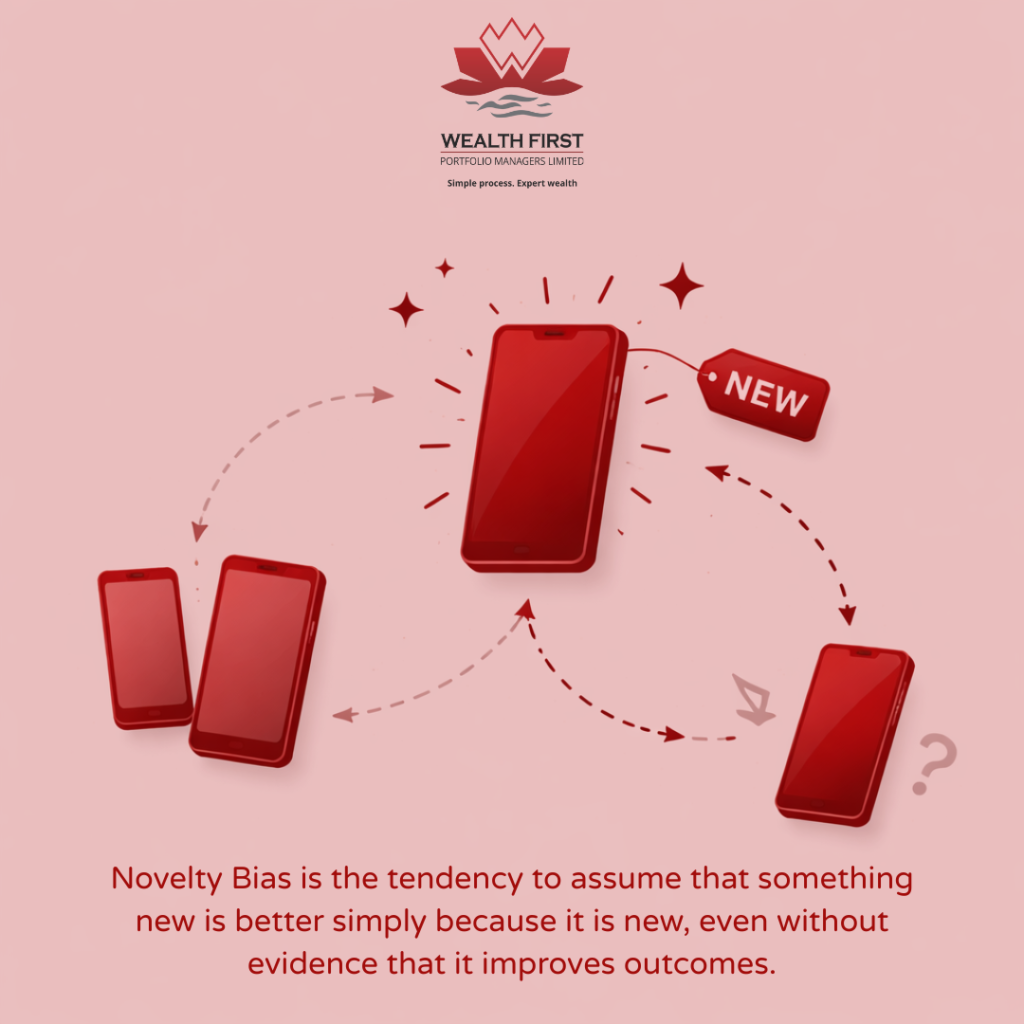
Novelty Bias is a behavioural tendency where individuals favour options that appear new or unfamiliar within a set of choices, assuming they are superior simply because they have not been considered before. This preference does not depend on the option being objectively better or recently created; rather, it arises from the belief that progress naturally improves outcomes over time. When faced with multiple alternatives and uncertainty about the best path forward, attention often shifts to the novel option, leading people to choose “new” over familiar such as opting for a new phone under the assumption that it must be better than the existing one.
Jigar’s lack of process in cooking the new recipe each time and failing to keep a written record of it shows his behavioural pattern. While his love for all the new recipes is exciting, his novelty bias made him blind towards what’s actually good for him.
In the same way, when an investor’s decision of investing in a particular medium or vehicle, is influenced and driven by his/her obsession with the novelty, it might result into unpleasant circumstances like Jigar. He had a bad stomach pain because he didn’t realise he had mixed two opposite-natured ingredients, which ended up hurting him. In portfolios, the same pattern can show up as mixing too many trendy products or themes without checking whether they truly work together, or whether they suit the investor at all. The problem wasn’t experimentation itself; it was the assumption that ‘new’ automatically meant ‘better’, and the refusal to build a repeatable process around what actually worked.
In investing, this urge for ‘the next new thing’ can quietly replace the slower work of following a plan.
How can you prevent the Bias?
- Do a fundamentals-first scan: Before the “new” excites you, check the basics – value, risk, and real-world usefulness.
- Give it a past test: Ask, “When similar ‘next big things’ showed up earlier, what actually happened?” Use history as a reality check.
- Keep position sizes sensible: Curiosity is fine; over-commitment isn’t. Avoid concentrating too much capital in only novel assets.
- Try asking following questions the moment you feel boredom and want to try something novel:
- Would I still like this if it wasn’t new?
- What could go wrong that the hype isn’t pricing in?
- What’s the boring, proven alternative and why am I ignoring it?
After the stomachache, Jigar realised that his enthusiasm for new cooking experiences was not the real problem. The problem was treating ‘new’ as automatically better, without any process. He finally understood that ‘new is NOT better all the time’.
So instead of stopping experimentation, he made a small change: he began writing down the base recipe when something worked, and kept his bold experiments to smaller portions. One plate was for comfort, one for curiosity.
In investing too, there is room for exploring new ideas as long as they sit on top of a well-thought-out core plan, not instead of it.
Key Takeaways
- Novelty bias can make “new” feel automatically superior, even when the older, proven choice is actually better for you.
- A lack of process means you can’t reliably repeat what works in kitchens or portfolios, so every decision feels like starting from scratch.
- In investing, this often shows up as chasing the next product, theme, or strategy, while neglecting the steady plan that fits your goals.
- The antidote is not to avoid all new ideas, but to anchor them to a clear process: fundamentals first, small position sizes for experiments, and written rules for when to stop or continue.
- Curiosity is healthy; it just needs a structure so that novelty becomes a small, controlled ingredient not the whole recipe.