

Subtitle: When (over) confidence shouts louder than reality.
Mayur had always been “the smart one”. He was in school toppers’ group, exceeded family expectations, always had juniors asking him for tips, and so on. So, when he signed up for a competitive exam, he carried that identity with him. “Quant? Easy. Logical? Done. English? I’ll manage,” he’d say with a half-smile to himself. To “get a feel” of the exam, he started giving mock tests on his laptop. The first mock result came in: Quant was decent, but not spectacular. Logical was okay, with a few silly mistakes. Verbal was weak; especially reading comprehension and inference.
The platform flashed suggestions: “Focus on reading comprehension. You are consistently misinterpreting passages.” Mayur scrolled past it. “It’s just one mock,” he told himself. “I know I’m good at this. I was just tired today.”
The second mock said something similar. So did the third. Verbal stayed weak, timing stayed off, careless errors kept repeating. But in Mayur’s mind, the story was different:
“These are just practice runs. On the real day, I always perform.” He tinkered a little with his schedule, but never truly changed his preparation. He liked the idea of being ready more than the discomfort of admitting he wasn’t.
On the exam day, walking into the hall, he felt confident. Walking out, he felt less sure.
The paper was tougher than he expected. Verbal felt like quicksand. Time slipped. Doubt crept in. Weeks later, when the results arrived, his score was lower than every mock had quietly warned him about. For the first time, he had to ask: Was the exam unfair; or was his confidence uncalibrated?
Understanding Overconfidence Bias
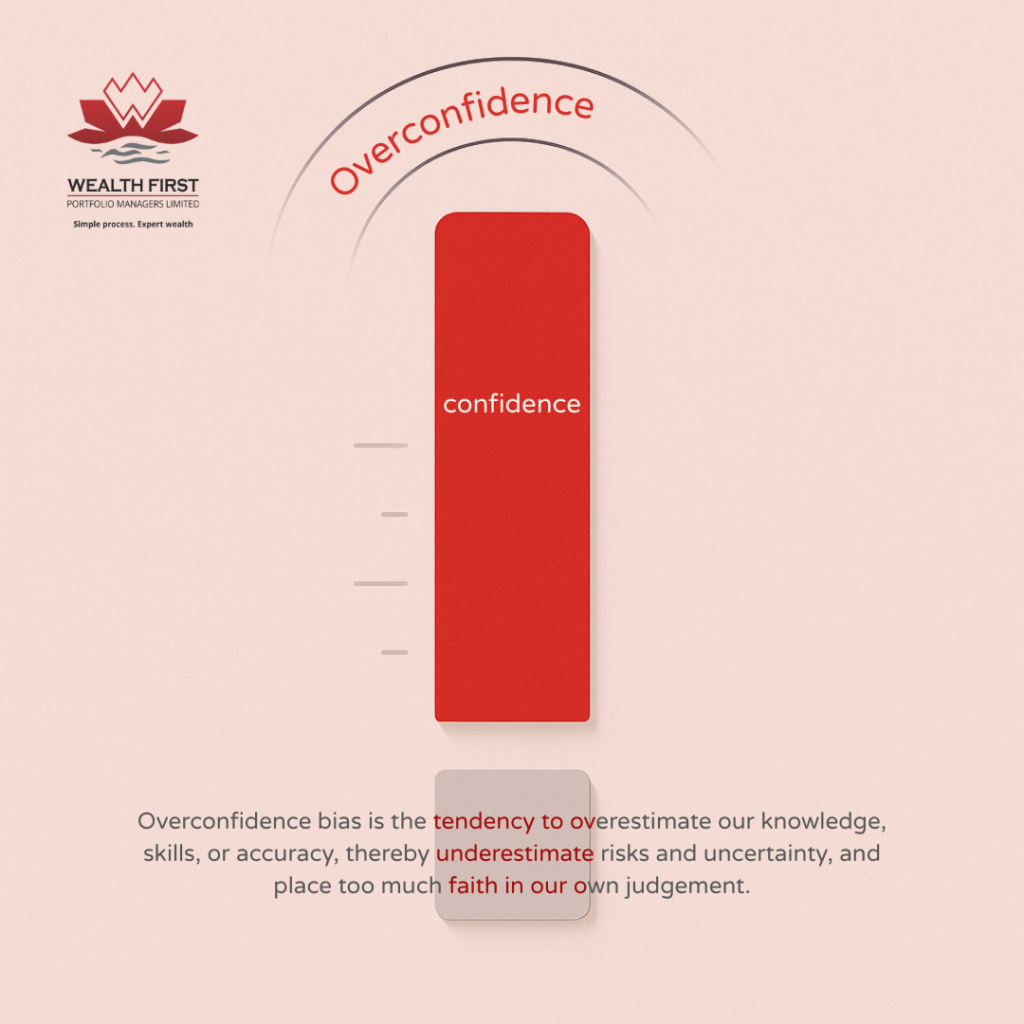
What Mayur experienced is a classic case of overconfidence bias. In simple terms, overconfidence bias is the tendency to overestimate our knowledge, skills, or accuracy, thereby underestimate risks and uncertainty, and place too much faith in our own judgement.
Behavioural economists call it the overconfidence effect which occurs when our subjective confidence in our ability is higher than our actual performance. In everyday life, overconfidence shows up as we experience similar thoughts like Mayur in our heads:
- “I don’t need to revise; I already know this.”
- “I can start late and still finish on time.”
It then, showed up as ignoring mock test feedback, dismissing repeated patterns of weak performance and finally, believing that the “real exam” would magically align with his own knowledge. Confidence itself is not the problem. Uncalibrated confidence certainly is.
Overconfidence in Finance
The same bias that made Mayur ignore his mocks often makes investors ignore their risk, process and limits. In finance, overconfidence bias can lead investors, analysts, or portfolio managers to believe they have more control, skill, or insight than they actually do. It actually shows up in following ways:
1. Trading too frequently
Research has repeatedly found that overconfident investors trade more often. Multiple studies have found that highly overconfident investors tend to take aggressive and excessive trading strategy, which ultimately leads to poor investment performance.
2. Underestimating risk
An Investopedia article notes that overconfidence can manifest itself in various ways, such as an inflated sense of control, unrealistic optimism, or underestimating the risk involved in a situation.
3. Ignoring feedback
Just as Mayur brushed off his mock scores, investors often ignore performance reviews that may highlight inconsistency, dismiss risk reports, or attribute gains to skill and always losses to “temporary noise”.
4. Mistaking a good outcome for a good process
If an impulsive trade works out once, overconfidence can make it feel like proof of skill; even if it was just luck. This reinforces the belief: “I know what I’m doing,” and weakens the willingness to question one’s own methods or strengthen the strategy. Over time, this can quietly erode discipline in diversification, rebalancing, and goal alignment.
A few days after the results, Mayur finally opened his mock test dashboard again. This time, he didn’t scroll past the feedback. He read it slowly. He saw the pattern of same question types being wrong again and again. The mocks had never lied to him. He had simply chosen not to listen. Instead of blaming “tough luck”, he did something harder: he admitted that his overconfidence had run ahead of his preparation.
For his next attempt, he made three changes:
- He treated feedback as data, not insult.
Every mock result was a mirror, not a verdict. - He separated identity from performance.
Being “the smart one” stopped being the goal. Being prepared did. - He calibrated his confidence.
His goal was not to feel confident, but to earn that confidence through verifiable progress.
In investing, that would look like checking actual long-term returns against an appropriate benchmark, measuring risk taken to get those returns, and devising and following a proper asset allocation strategy.
Mayur eventually did better in his next exam. Not because he became less confident, but because his confidence and reality finally matched.
Key Takeaways
- Overconfidence bias is not about having any confidence; it’s about wrongly calibrated confidence.
- Ignoring feedback from markets is a classic symptom. In investing, overconfidence often leads to excessive trading, higher costs, poor diversification, and weaker long-term returns.
- The antidote is calibration: checking beliefs against data, returns, risk, and real-world feedback.
Disclaimer
The content shared by Wealth First is for general informational and educational purposes only and should not be considered as investment advice, research, or a solicitation to buy or sell any financial product. Past performance is not indicative of future results. All investments are subject to market risks, including possible loss of principal. Readers should consult their financial, legal, or tax advisors before making any investment decisions tailored to their personal circumstances. While utmost care is taken to ensure accuracy of information and concepts, Wealth First does not guarantee completeness, reliability, or timeliness, and shall not be liable for any direct or indirect loss arising from reliance on such information. All articles contain no offer, inducement, or solicitation for account opening, investment, or trading activity. All characters, events and examples are fictional and used only for illustrative storytelling. Wealth First, its employees, and affiliates expressly disclaim any liability arising from interpretation or use of this material.