

Wealth First explains how XIRR helps you measure what your money truly earned, not just what it grew to.
Imagine you’ve planted a tree, but instead of watering it once at the beginning, you water it irregularly: sometimes more, sometimes less, sometimes skipping months altogether depending on the weather and external conditions.
When the tree grows, how do you calculate how efficiently your watering actually helped it grow? That’s exactly what XIRR does for your investments. It measures real growth, taking into account when and how much you invested and when you withdrew.
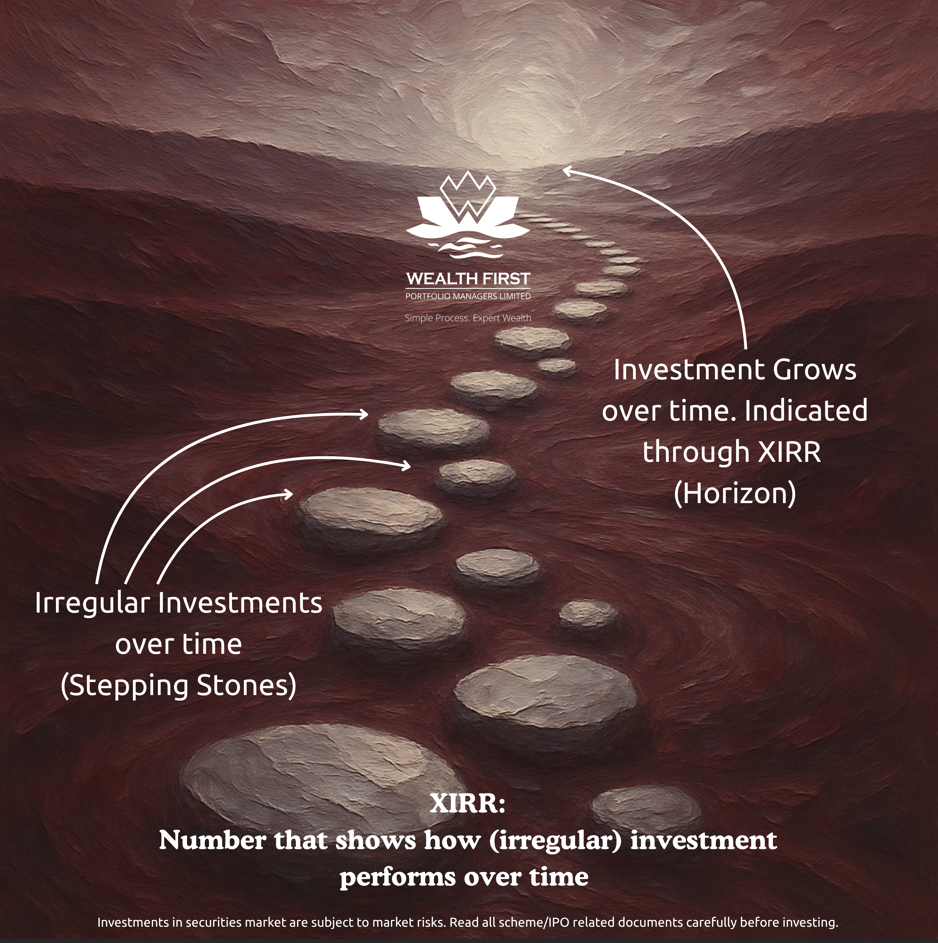
What Is XIRR?
XIRR, or Extended Internal Rate of Return, is a method to calculate your actual annualized return when investments happen at different times and amounts.
Unlike simple return methods that assume one-time investment and one-time redemption, XIRR reflects real-world investing patterns where you might invest monthly (SIPs), add lumpsum amounts in-between, withdraw partially, or top-up occasionally.
In simple terms:
XIRR tells you how efficiently your money has grown over time, considering all inflows and outflows.
That’s why it’s called “Extended” IRR because it extends the standard internal rate of return formula to handle irregular cash flows.
Measuring Uneven Watering
Think of your portfolio like a tree:
- Each time you invest, it’s like watering the tree.
- Each time you withdraw, it’s like pruning a branch or picking fruit.
- Over time, the tree grows. But, it’s not just because of one time of watering.
If you want to know how efficiently your watering led to the tree’s growth, you’d use XIRR because it considers every drop and every moment of care.
That’s what makes XIRR far more realistic than one-dimensional measures like absolute return or CAGR.
Example: How XIRR Works
Let’s say you invest through a SIP:
- ₹10,000 every month for 3 years (total invested amount = ₹3,60,000)
- The value after 3 years = ₹4,20,000
Now, you might think your gain is ₹60,000 on ₹3,60,000. A simple 16.7% total gain.
But that doesn’t tell the full story, because the first ₹10,000 was invested 36 months ago, while the last ₹10,000 was invested just 1 month ago.
When you calculate XIRR, it shows your actual annualized return as an example, at around 9.8% per annum, which reflects the timing and compounding of every contribution.
XIRR vs. Absolute Return
| Aspect | Absolute Return | XIRR (Extended Internal Rate of Return) |
| Definition | Total gain or loss over the investment period. | Annualized rate of return considering cash flow timing. |
| Suitable For | One-time investments. | SIPs, multiple investments, or irregular inflows/outflows. |
| Formula Simplicity | Simple percentage difference. | Advanced computation (done via tools like Excel or calculators). |
| Usefulness | Basic snapshot. | Real-world performance measurement. |
Absolute return tells how much you earned; whereas XIRR tells how efficiently you earned it.
XIRR vs. CAGR
| Aspect | CAGR (Compounded Annual Growth Rate) | XIRR (Extended IRR) |
| Investment Pattern | Single investment, single redemption. | Multiple or irregular investments and withdrawals. |
| Purpose | Simplified measure of compounded growth. | Realistic measure of actual investor experience. |
| Accuracy | Works best for lump-sum investments. | Best for SIPs, STPs, or goal-based investments. |
CAGR is like measuring the growth of one tree you planted once.
XIRR measures the growth of an entire garden you’ve been nurturing irregularly over time.
When and Where XIRR Is Most Useful
XIRR gives the most accurate picture when:
- You have SIP or recurring investments.
- You make irregular withdrawals or redemptions.
- You have multiple investments across different timeframes.
It’s also used by:
- Mutual fund and PMS reports to show investor-specific performance.
- Financial planners to track how a client’s total portfolio performed over time.
Other Things to Know About XIRR
- Tools to Calculate It:
You can calculate XIRR easily with the help of Wealth First’s XIRR calculator. - XIRR Can Be Negative:
If your portfolio’s current value is lower than total inflows, XIRR will show a negative figure which reflects real losses. - XIRR Is Personalized:
Two investors in the same mutual fund can have completely different XIRRs depending on when they invested or withdrew.
Key Takeaways
- XIRR measures real-world portfolio performance by considering the timing and size of all investments and withdrawals.
- It provides a true, annualized rate of return, unlike simple or absolute returns. It reflects the real investor experience.
- CAGR works for single investments, but XIRR is ideal for SIPs, STPs, and irregular cash flows.
- If CAGR tells the story of one race, XIRR tells the story of every step you took along the way.
👉 Explore our Wealth Calculator to measure XIRR on your portfolio.
Disclaimer
The content shared by Wealth First is for general informational and educational purposes only and should not be considered as investment advice, research, or a solicitation to buy or sell any financial product. All information in emails, posts, and articles from Wealth First is intended solely to increase financial awareness. Past performance is not indicative of future results. All investments are subject to market risks, including possible loss of principal. The given example(s) is/are only for illustrative purposes only and hypothetical in nature. Readers should consult their financial, legal, or tax advisors before making any investment decisions tailored to their personal circumstances. While utmost care is taken to ensure accuracy of information, Wealth First does not guarantee completeness, reliability, or timeliness, and shall not be liable for any direct or indirect loss arising from reliance on such information.