
Subtitle: Why rare risks feel distant until they don’t.
Mira had always been cautious about digital security. She used strong passwords, enabled two-factor authentication, and regularly updated her apps.
One afternoon, her friend forwarded a news clip: “Major cyber-attack compromises millions of users worldwide.”
Within minutes, Mira felt a surge of panic. She changed every password she had, deleted dozens of apps, reset her devices, installed new security programs, and spent the rest of the night anxiously checking forums for updates.
Two days later, it turned out the breach was restricted to an outdated version of a software she didn’t even use. It never affected her at all. Ironically, a week earlier, her company had offered employees the option to back up critical files. Mira skipped it.
It felt routine. Boring. “Nothing will happen to me,” she thought. Her fear responded not to probability, but to emotion.
Understanding Probability Neglect
Mira’s behaviour reflects a subtle yet powerful cognitive distortion called probability neglect.
What it means
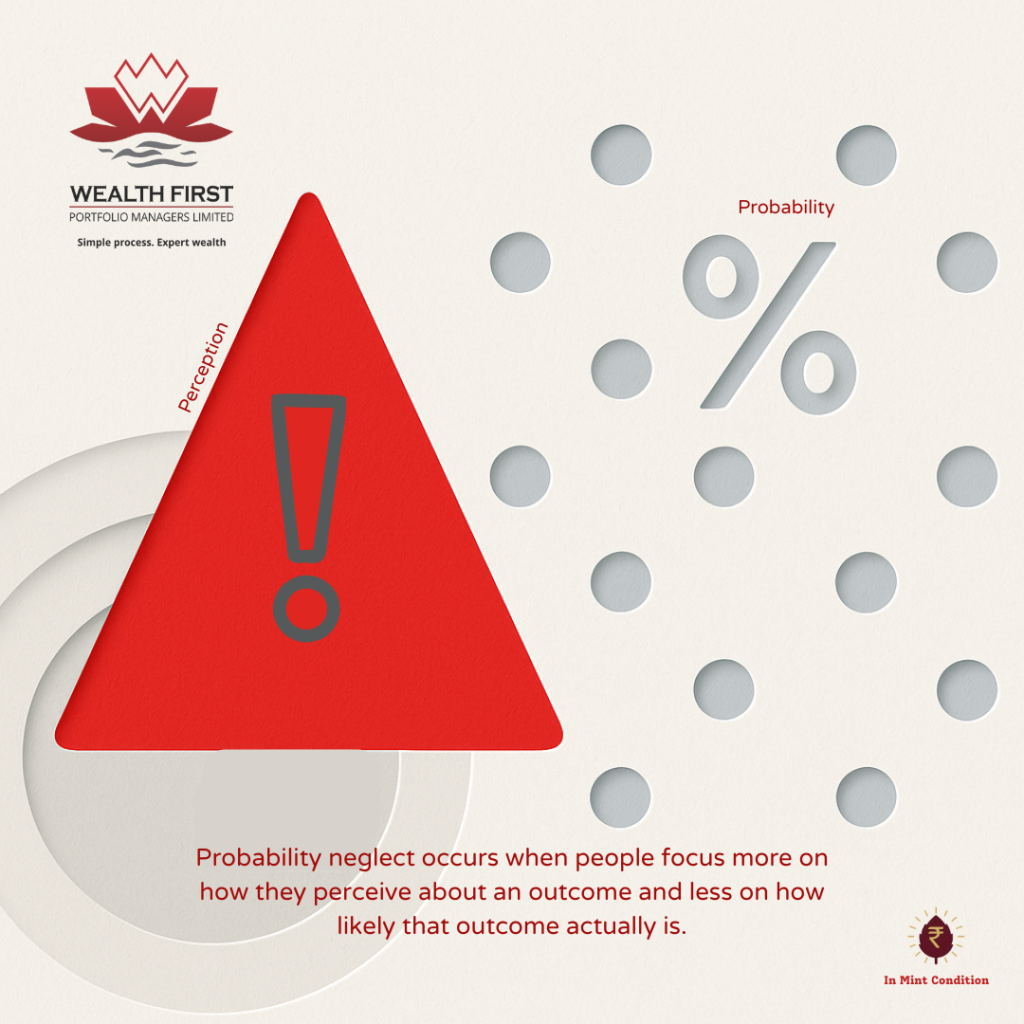
Probability neglect occurs when people focus more on how they feel about an outcome and less on how likely that outcome actually is.
In other words: We react strongly to vivid risks while ignoring mundane risks; even when the mundane ones are far more probable. When the worst case produces intense fear, little role is played by the stated probability that that outcome will occur. The behavioural mechanism is simple:
- dramatic threats → overreaction
- routine risks → underreaction
This is why people obsess over viral news but overlook structural issues that matter far more. Emotion overpowers calculation.
Probability Neglect in Finance
Nowhere is this bias more consequential than in financial decision-making. Investing involves uncertainty, but not all uncertainties are equal. The risks involved are not often given the attention they deserve compared to the potential rewards they can bring. The problem is that people rarely evaluate risks by actual likelihood.
Instead, they respond to recent unrelated shocks, visceral headlines, personal stories, fear of missing out, etc.
How this bias shows up
1. Overreacting to rare market events
People often panic about low-probability, high-drama scenarios such as sudden crashes, global events, viral financial rumours, etc.
Yet the statistical likelihood of these extreme outcomes affecting long-term portfolios is usually small; especially for diversified, long-horizon investors. Do note again that there is still a probability, even if that is very miniscule, of those rare events happening. The problem only lies when the emotions take over rationality.
2. Underestimating slow risks
Common, probability-heavy risks are neglected because they lack drama, or are not emotionally appealing for a lot of individuals such as inflation eroding savings, concentration risk, no emergency fund, etc.
These mundane risks are far more likely to hurt financial outcomes than rare ones.
3. Falling for anecdotal evidence
One friend who doubled money quickly can overshadow decades of market data. One story of loss can overshadow years of disciplined compounding. Emotion beats probability.
Probability neglect also explains why many people prefer schemes promising “zero risk” (which don’t exist in reality). Every financial instrument carries some risk, including the safest ones. Ignoring this often leads to misplaced confidence or vulnerability as well.
A week after the cyber-security scare, Mira’s office network crashed. A server malfunction corrupted several files, including hers. The IT team asked if she had completed the optional backup. She hadn’t.
There was no dramatic headline. No panic-inducing news clip. Just a simple, probable risk she ignored. That evening, she realised something powerful: Probability wasn’t the problem. Her perception of probability was.
She set a weekly digital hygiene routine. Not based on panic, but on likelihood keeping in mind that the real risks were not the ones that frightened her most, but the ones she rarely thought about.
Key Takeaways
- Probability neglect distorts decision-making by amplifying emotional threats and minimising realistic ones.
- Common & slow risks are often ignored, despite being far more consequential.
- In finance, understanding likelihood is as important as understanding risk.
- Preparedness comes from perspective, not from reacting to fear.
Read Next
- In Mint Condition: The Mirror of the Moment — Myopic Loss Aversion, explained
- Wealth First Explains: Risk Tolerance — Know your comfort zone before investing
Disclaimer: The content shared by Wealth First is for general informational and educational purposes only and should not be considered as investment advice, research, or a solicitation to buy or sell any financial product. Past performance is not indicative of future results. All investments are subject to market risks, including possible loss of principal. Readers should consult their financial, legal, or tax advisors before making any investment decisions tailored to their personal circumstances. While utmost care is taken to ensure accuracy of information and concepts, Wealth First does not guarantee completeness, reliability, or timeliness, and shall not be liable for any direct or indirect loss arising from reliance on such information. All articles contain no offer, inducement, or solicitation for account opening, investment, or trading activity. All characters, events and examples are fictional and used only for illustrative storytelling. Wealth First, its employees, and affiliates expressly disclaim any liability arising from interpretation or use of this material.